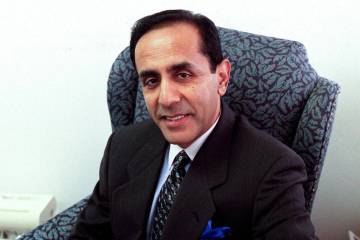
Ever since I read a passage in University Chancellor Jim Rogers’s speech on the state of the system, I’ve been casting about looking for some way to compare his stats with those of other states.
This is what Rogers said:
“The state pays about 80% of the System’s cost. The student pays 20%. If the state were to cut its contribution by 36%, the state would then contribute 51% and the students would contribute 49%, an increase of more than two and a half times our current tuition and fees. An increase in tuition and fees to fill the hole the Governor describes would make tuition and fees so high that it would be cheaper to go out of state to college. At a time when more Nevadans are unemployed and underemployed than ever before, how many could afford to attend Nevada’s colleges?”
Eureka, I found it.
It turns out the Delta Project on Postsecondary Education Costs, Productivity, and Accountability looked at how much the nation’s universities are subsidized by taxes and how much is paid by student tuition.
The stats are a couple of years old now and were trending upward every year, so there is no telling what the stats are now.
Here is what Delta Project found:
“Students are paying more of the total cost of their education at all institutions except private research universities. From 2002 to 2006, the share of educational costs represented by student tuition rose from just over one-third to nearly one-half at public four-year institutions. At private master’s and bachelor’s institutions, students are paying between 75 and 85 percent of the full cost of their education.”
Andrew Clinger's presentation on the state budget gave a breakdown of NSHE finances (slides 30-35):
http://budget.state.nv.us/budget_2009_11/presentations%5CBudget%20overview%2009-11.pdf
His presentation shows that taxpayer funding makes up 51.3 percent of the cost for NSHE while the national average is 32.6 percent. Only taxpayers in Alaska, Florida, and DC pay higher shares.
The big difference in Nevada is that "other funding" sources such as university endowments cover a miniscule 33.1 percent of costs compared to a 49.6 percent national average.
His reporting looks like it reflects FY09 data.
Education is the key to your future as well as our Mitchell. Get with the program.
What is occurring with Nevada education funding is a political creation from the tax and spenders. The UNLV debate is just a microcosm of a larger sense of entitlement that has been purveyed by the left.
This engineered "vox populi" is now the strongarm used by those that want what they have not earned.
It appalls me that much of the reinforcement for this groundswell of created need is coming from academia. Take a look at today's op-ed from Nobel laureate Paul Krugman (http://www.nytimes.com/2009/01/26/opinion/26krugman.html?th&emc=th), saying in part,
"So as a public service, let me try to debunk some of the major antistimulus arguments that have already surfaced. Any time you hear someone reciting one of these arguments, write him or her off as a dishonest flack."
Hard to believe his award was for economics.
So there you have it. A wonderfully engineered program to create entitlements. And, if you disagree, you are somehow a flack...
Statistics like the "Delta project" can be misleading. Is this a national study? How does this compare to regional universities that compete with UNLV/UNR for students?
I have two college bound students within the next two years. I am willing to pay more tuition, but if it exceeds the amount for Utah universities, my sons will enroll there. They are both very bright students and will have no problem getting accepted there...
Where is the "middle ground" here? Can't there be some combination of student tuition increase, program cuts and additional revenue that can help the Nevada Higher Education system get through this?
It would be great to see you follow up with legislators, university regents, etc to allow your readers to gain a vision of possible multi-layered solutions rather than just the "doom and gloom" put out by the Governor's and Chancellor's offices.
It's worth noting that Krugman's Nobel Prize was granted for his work in international trade. This is the only field of economics which he has a clear grasp on - he actively highlights the merits of free trade and the resulting productivity increases.
His Keynesian philosophies rely on a closed-market presumption that is completely inconsistent with his free trade viewpoint. Moreover, this part of his warped ideology is regularly eschewed by the majority of academic economists.
http://npri.org/publications/welcome-to-the-long-run
P.S. Chancellor Rogers wanted a salary of $1 but is required by law to collect $22,000, which he donates to charity (look it up). And he's donated millions of dollars to higher education in Nevada, Arizona, and CA.
Speaking of Krugman, maybe you should look up his writing on the "gains from trade."
You're advancing a mercantilist argument with regard to higher education. There is no "market logic" to a mercantilist economy. In fact, markets replaced mercantilism in the late eighteenth century.
The "market logic" is that countries, states, and even individuals should specialize in the areas in which they enjoy a "comparative advantage" and then trade with others to acquire the other things they need. This maximizes overall wealth.
Higher education is a tradable good like anything else. If someone else is able to provide a better bargain for higher ed, then consumers should take advantage of it. That money will come back into the state as out-of-staters trade for entertainment or other goods and services that Nevadans provide relatively more efficiently.
Drop me an e-mail. I have a question for you.
Yeah, put that on your recruiting advertisements. Okay...
That strategy is working very well right now, by that way, as our "recession proof" economy is among the hardest hit.
There is nothing wrong with trading with those states for higher ed services. If Nevadans were willing to engage in interstate trade, one would likely find that many industries would arise for which Nevada enjoys a comparative advantage.
In many cases, students would be better off by going to trade schools and the like.
You appear to acknowledge that many degrees are not worth the investment by citing cost concerns. Indeed, I agree with you. Subsidizing higher education encourages more people to pursue degrees that do not merit the investment - because the cost is sluffed off on other people.
If a student wants to pursue a degree that is worth the investment, he/she should have little difficulty securing financing to go to an elite school. Public and private loans are readily available for higher education.
I'm not saying that people should categorically choose not to value higher education. I'm simply highlighting the fact that in many cases it does not merit the investment and simply saddles the student in unnecessary amounts of debt - all because as a society we have oversold the notion of higher ed.
Nevada illustrates this point very well. Despite the fact that levels of higher ed are relatively low, per capita personal income is 7th in the nation. Nevadans have discovered that higher ed degrees are not, in every case, a requisite for success.
Good article on issue:
http://abcnews.go.com/Business/Economy/story?id=6654468&page=1
But I agree one doesn't need a college degree to park cars, deal cards, or turn sheets. That seems to be the belief of the gaming/power establishment. "The world needs ditch diggers, too." And Nevada ranks #1 in its production of ditch diggers. Another marketing slogan!
That's also why the median age of UNLV students is higher than national average, by the way. The students shortly realize they need an education to advance out of the entry-level service jobs.
If one is investing in an engineering, physics, chemistry, computer science or other technical degree, then the four-year university is a good investment.
If, on the other hand, the student is seeking a degree in art, drama, women's studies or other such degrees for which there is little to no demand within society, then the only reason it is seen to be a good investment is because the student can force others to pay for it.
Higher education is often sold as being meritorious in and of itself, regardless of the program of study. This leads to a gross mis-allocation of resources, an unnaturally high demand on the educational establishment and, hence, skyrocketing costs.
Remember that the purpose of education is to acquire marketable skills. A bachelor's degree is not the only means of doing this. Indeed, many students earn a four-year degree without ever acquiring marketable skills of any type. Throwing money away blindly at an educational establishment does not make anyone more or less qualified. Nor does the lack of a four-year degree indicate a lack of intelligence or critical thought. Once again, how many college graduates truly display critical thought? A very small minority.
BTW, the majority of subsidized "green" jobs will be in simple manufacturing. Those jobs do not generally require a four-year degree of any type. It's actually moving backwards from an information-based economy to an economy resembling that of the 1950s.


RSS
Comments (19)
Registration Notice: The Review-Journal has implemented a new registration procedure that requires all existing and new accounts to validate and login using Facebook. Visit the Registration FAQ for more information.
Share your thoughts on this story.
Sign in or register to make a comment.
Some comments may not display immediately due to an automatic filter. These comments will be reviewed within 24 hours. Please do not submit a comment more than once.
Note: Comments made by reporters and editors of the Las Vegas Review-Journal are presented with a yellow background.