Home Subscribe Las Vegas Review-Journal
  Jobs Cars Homes Shopping Travel Weddings Golf Best of Las Vegas Photo   Search:

RECENT EDITIONS
Mon Tue Wed Thu Fri Sat Sun

Business


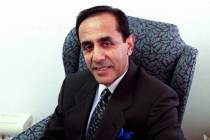
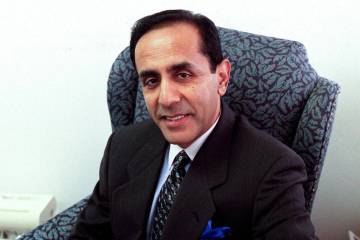
NEVADAN AT WORK: With hand in operations, construction and finance, exec helps Las Vegas Sands thrive


Photo by Sara Tramiel/Review-Journal

At age 29, Brad Stone was the youngest president of a hotel-casino in Atlantic City. He had overseen lodging and gaming at the Boardwalk resort at different times when Pratt Hotel Corp. decided to place him in control of the entire property.

The Pratt president who gave Stone the opportunity was Bill Weidner, now the president of the Las Vegas Sands Corp.

During that tenure, Stone interacted with other Atlantic City casino operators.

"I was sitting around the table with Donald Trump and Steve Wynn and they were looking at me saying, 'Who is this kid?'" Stone said. "And I was a young-looking 29."


Most Popular Stories
  • Lake Las Vegas seeks Chapter 11 protection
  • At last, Durango Station details
  • Owner of Fitz under attack
  • New-home sales hold steady in LV
  • Is any bank really safe now?
  • RECORD PAYDAY
  • MCCARRAN INTERNATIONAL AIRPORT: County approves third terminal
  • Condo buyers struggling for closure amid credit squeeze
  • Starbucks to close 17 LV Valley stores
  • DEVELOPMENT: A WHOLE LOT OF NOTHING GOING ON


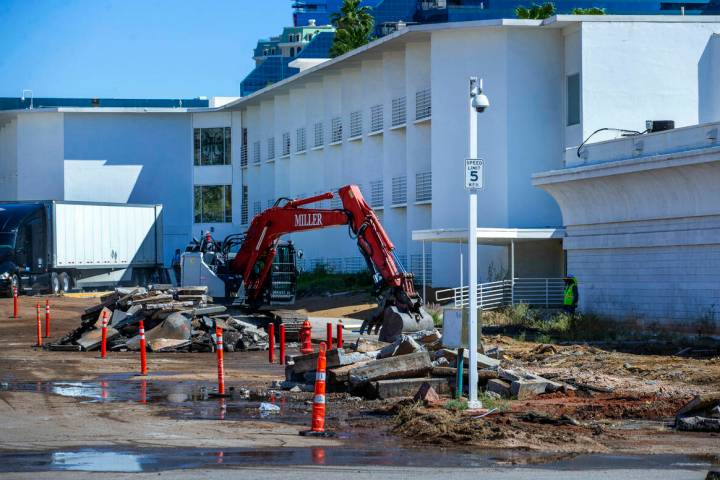
  • Stone said the Sands Atlantic City, which was closed and imploded last year, was "a pretty lousy property," but he was able to churn out roughly $50 million annually in cash flow.

    "People looked at us and wondered how we could manage that kind of cash flow," Stone said.

    It also caught the attention of Las Vegas Sands Chairman Sheldon Adelson, who was looking for an experienced executive management team to help transform his Sands Las Vegas into The Venetian and create a corporation. Stone came west in 1995 with Weidner and Rob Goldstein.

    Today, Las Vegas Sands, which celebrated the grand opening of its second Strip resort, the $1.9 billion Palazzo, on Thursday, is worldwide casino company with a market capitalization of almost $30 billion.

    Stone oversees the company's construction projects. In addition to the Palazzo, in 2007 he managed an expansion to the Sands Macau and construction of the $2.4 billion Venetian Macau.

    Las Vegas Sands is now spending $12 billion to build nearly a dozen hotel-casinos on Macau's Cotai Strip. Also, the company is building a $4.6 billion hotel-casino in Singapore and a $637 million casino and entertainment development in Bethlehem, Pa.

    Question: How did you get involved in the construction side of the business?

    Answer: It was sort of baptism by fire. I went to Cornell University, where I took some engineering courses and architectural courses.

    I knew some things about mechanical and electrical systems, enough to be a little dangerous.

    A lot of what I bring to construction and design is the best of both worlds. I'm the end user of the product I create. If I screw it up and it doesn't work or meet the mark, I can't blame anyone but myself. I have the responsibility of getting our projects designed and built, so I have the responsibility of creating our cash flow, too.

    Question: Do you bring a different outlook to the company's construction projects?

    Answer: Part of my job is to bring more of a business perspective to the construction side.

    For example, we buy cranes and we buy specialty equipment because it's a lot cheaper than renting them. I'm very conscious of the return on invested capital. Most guys who build these places aren't necessarily thinking of operating them day to day. When we are sitting around making a design or construction decision, I bring up how it translates into the property's operating and the generation of cash flow.

    Question: Do you have roles with the company outside of construction?

    Answer: I'm actively involved in the company's operations. I probably spend about 50 percent of my time on the construction side, about 30 percent on the operations side and 20 percent on the financial side. I still meet with investors and I some involvement in the presentations for the financing.

    Question: What's unique about Las Vegas Sands approach to growth?

    Answer: We have a full plate because we tend to build things from scratch. We're not an acquirer of companies because you usually have to pay a premium for cash flow. That's why we like to create the cash flow ourselves by starting from the ground up.

    Question: The company has projects in different parts of the world. What is the similarity that runs through each destination?

    Answer: They are all complicated in their own way. I learned from building The Venetian that we will never depend on anybody but ourselves to have the horsepower and wherewithal to get these things done.

    We are intimately involved and just not casting faith to some general contractor or construction manager. We may use general contractors or construction managers, but I want us to be running the show.

    Question: What are some of the differences in each market?

    Answer: In China the key thing to be successful is management. Las Vegas has a pretty sophisticated work force in terms of the contractors and workers and supervisors. Macau is a less sophisticated work force and it needs more supervision.

    In each market, we make sure enough of our own people are supervising and watching the development. That way, I don't have to take someone's word for it.

    Question: What have you found interesting about building the Marina Bay Sands in Singapore?

    Answer: Most of the analysts don't understand what the value of Singapore will be. It's a unique product for the Asian consumer in a world-class city. There is only one other competitor and it has a very reasonable tax rate. It's important to us because its going to yield significant (cash flow) and returns.

    Question: You're originally from back East. Was that a reason for building in Pennsylvania?

    Answer: We knew this location was a sweet spot. There is a lot of wealth in that Interstate 78 corridor between Manhattan and Bethlehem. For that area of New Jersey, it's about 45 minutes to an hour to get Bethlehem, versus two-and-a-half hours to Atlantic City.

    We'll put our business model into place, and even though there is a fairly aggressive tax rate, we think we can make the type of returns on our investment that we need to succeed.

    Question: Part of development is preserving portions of the Bethlehem Steel Mill. What type of challenges does that present?

    Answer: This is a legendary company that built battleships and the Golden Gate Bridge. There is a lot of heritage there.

    The building has gone through some transitions and we're finding that balance of respecting the town and its heritage and also leveraging that into what makes the property more interesting.

    Question: Why has your management team has stuck together going on 13 years?

    Answer: It's exciting for me because I get to take Sheldon's vision and translate it into assets and cash flow. I always kid that I'm like the guy in the old Rocky and Bullwinkle cartoons sweeping up after the parade.

    I'm trying to keep up with the big idea guys like Sheldon and Bill. My job is to get the ideas built and open and Rob's job is to operate them on a daily basis.

    It's an interesting combination of people. While we're a big company, we move quickly because its a small core group of people who make the decisions.

    Contact reporter Howard Stutz at hstutz@reviewjournal.com or (702) 477-3871.


    Leave Your Comment 2 Reader Comments
    Terms & Conditions
    The following comments are provided by readers and are the sole responsiblity of the authors. The reviewjournal.com does not review comments before publication nor guarantee their accuracy. By publishing a comment here you agree to abide by the comment policy. If you see a comment that violates the policy, please notify the web editor.

    Some comments may not display immediately due to an automatic filter. These comments will be reviewed within 48 hours. Please do not submit a comment more than once.
    Current Word Count:

    John wrote on January 21, 2008 08:37 AM: That's right, keep taking the money you make in "no-tax Nevada" and building everywhere else. By the time Nevada gets its head out of its rear and raises the gaming tax, these companies will be well entrenched elsewhere and will just say "see ya!" Then we'll see what kind of jobs the people who got the #48 in the nation quality education can get.


    SANDTRAP wrote on January 21, 2008 08:19 AM: THE COMMENTS COMING FROM THE PALAZZO YESTERDAY ARE BOASTFUL, ARROGANT, AND CERTAINLY SHOW A LACK OF SCHMULTZ IN GAMING.

    THE COMMENTS WERE THAT YOU WILL SEE THE END OF THE FREE BROADWAY SHOWS IN LAS VEGAS. THE ONLY FREE BROADWAY SHOW IN LAS VEGAS YESTERDAY WAS THE CORPORATION THAT MADE THIS COMMENT AS AN EXHIBIT OF THEIR WORDLY CORPORATION.

    THE SPOKESPERSON FOR THE CORPORATION HAS AN IDEOLOGY OF PROPERITORSHIP BUT CERTAINLY NOT A LAS VEGAS IDEOLOGY. THE SPOKES PERSON IS REFERRING TO A SHOW THAT DOES NOT OCCUR IN LAS VEGAS.

    THE FREE SHOWS, SUCH AS WAYNE NEWTON'S EARLY YEARS ARE FREE TO THE PUBLIC. HOWEVER, BUYING SOME BEVERAGE IS ENCOURAGED AND THE LOUNGE SHOWS ARE ENCOURAGED TO DRAW THE CUSTOMER TO THE GAMING AREA WHERE THE COCKTAILS ARE FREE UNTIL THE PIT BOSS SAYS THE DRINKER HAS HAD ENOUGH TO DRINK AND ESCORTS THE PLAYER OUT OF THE CASINO.

    I HOPE THAT THE SPOKESPERSON FOR THE PALAZZO CAN REWORD THE DEDICATORY SPEECH INTO A MORE APPROPRIATE SPEECH THAT CONTAINS THE HISTORY OF THE STRIP AND THE HISTORY OF THE DOWNTOWN LAS VEGAS FROM THE EARLY HISTORY OF LAS VEGAS TO THE STEVE WYNN ERA OF CORPORATE OWNERSHIP AND CORPORATE IDEOLOGY.