Comments (1) | Add a comment
Architect revels in pursuing possibilities
-
GARY THOMPSON/LAS VEGAS REVIEW-JOURNAL
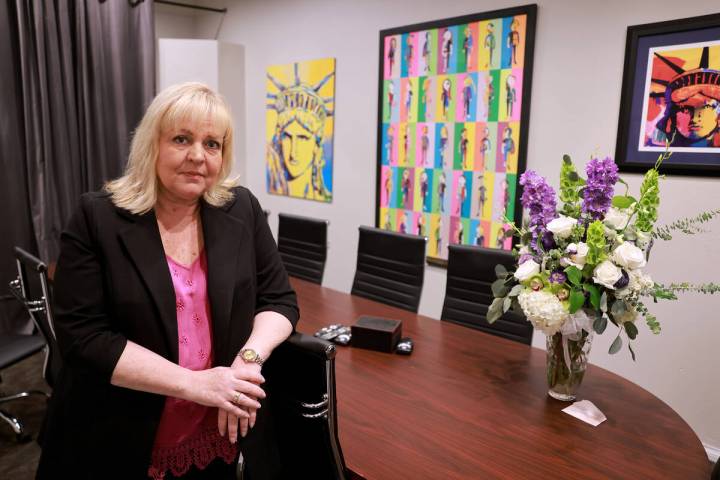
GK3 Architecture co-founder Gemie Knisely said affinities for design and problem-solving led her to a career in architecture. She and her husband, Kevin, founded GK3 Architecture in 2003. » Buy this photo
Tools
LAS VEGAS REVIEW-JOURNAL
When her parents talked about adding a room to the family home, Gemie Knisely thought about the possibilities -- what kind of space they could have and how it could be used.
That's when the seed was planted in her mind about becoming an architect.
"I knew I wanted to design spaces for people to enjoy and I love problem-solving," the owner of GK3 Architecture said at her home office in Las Vegas.
After graduating from Boulder City High School in 1997, Knisely enrolled in architecture school at the University of Nevada, Las Vegas, earning a bachelor's and master's degree.
She worked for local architecture firms Tate Snyder Kimsey and Paul Steelman while in college, then co-founded GK3 with her husband, Kevin, also an architect, in 2003.
They work out of a 1,500-square-foot guest home on the same property as the 8,000-square-foot custom home they're designing and building in the Scotch 80s neighborhood, near Charleston Boulevard and Rancho Drive.
"Our clients can see what we've done with this building," Knisely said. "We're not suit-and-tie architects. We're blue-jean architects. If our clients call, we take them immediately. There's no receptionist here to make an appointment. I'm the architect on the phone."
Business "went crazy" when the economy was booming, then started slowing in 2008 and took a drastic drop in 2009, she said. Billings are down about 70 percent, which is fine, Knisely said.
"We're slow and steady and we're surviving," she said.
Question: Why did you start your own firm?
Answer: That was always my longtime goal. We had the opportunity and we jumped on it. It was a little earlier than I had anticipated, but I was glad the opportunity was there. That was my end goal, to work for myself.
Question: How much capital did it require and how was it financed?
Answer: Nothing. It's low overhead working out of your home. We were set up because as an architect, you take your work home with you often. We already had computer equipment. We purchased a plotter for $5,000 and we had the money. That was our biggest expense.
Question: Does the drop in the American Institute of Architects' billing index accurately reflect the industry's business activity?
Answer: I don't pay too much attention to it, but I'd say definitely the amount of construction is way down, so it doesn't surprise me that there's a correlation between that database and what's being built. As far as remodel work, people are taking what they currently have and making it meet their needs. We just did a 7,000- or 8,000-square-foot addition to the laborers' union training building.
Question: Is your business focused on residential or commercial work?
Answer: The balance has kind of changed. When we started, it was 60 percent residential and 40 percent commercial. Then when real estate took a dive, we were probably 80 percent commercial. Now we're back to 60-40, or maybe 50-50.
Question: What do you like most about your work?
Answer: The funnest part is the design portion, but it's only a small part of a project. We want to meet the owners' needs. We're really focused on having a very good set of drawings to make construction go easier.
Question: What do you like least?
Answer: I'd say the building departments. Now that things have slowed down, they're a little bit quicker.
Question: Which projects would you say represent some of your best work?
Answer: We did the Western Technologies geotechnical building on Post Road. It was an unusual use. They had special needs for climate control to support their soil testing. We really like projects that have different and unique uses. As far as buildings that look good and are attractive, we did India Palace on Twain. If you saw the original and what we turned it into, you'd see it's amazing.
Question: How does the business relationship with your husband carry over to your personal relationship?
Answer: We couldn't be happier. We have our battles, but it doesn't affect our marriage. When we're in business mode, we take care of that. When we're husband and wife, we take care of that. Right now we're building our house, and that's where our whole marriage is, building the house and the business as one.
Question: How difficult was it to get your first job in architecture?
Answer: I taught first-year studio (design class) at UNLV and worked as an intern at Tate Snyder, and then I worked my second year with Steelman and after I graduated, we started our own business.
Kevin was my boyfriend and had been licensed for several years. We had an opportunity to do custom homes and an industrial park. I knew I wanted to work at home in my own studio and look out the window and see a tree.
Question: What was the percentage of female students in your architecture classes at UNLV?
Answer: There were three of us and probably a dozen or 15 guys. It started out large, but the graduating class was very small, maybe 10 or 12. People often go into architecture and then change their major. It takes a lot of time and dedication.
Question: How much do you charge for your services?
Answer: In a good economy, we were getting probably $5 a square foot. Now it's $2 to $3 a square foot on a good building. We do everything, architectural, mechanical, electrical and plumbing. A lot of times you hire engineers, but Kevin can handle all three disciplines.
With our overhead being low, our prices are very competitive. We've always been competitive and we've adjusted to the market.
Contact reporter Hubble Smith at hsmith@reviewjournal.com or 702-383-0491.


RSS

Comments
Terms & Conditions
The following comments are provided by readers and are the sole responsiblity of the authors. The Review-Journal does not review comments before publication nor guarantee their accuracy. By publishing a comment here you agree to abide by the comment policy. If you see a comment that violates the policy, please use the Report Abuse button.
Some comments may not display immediately due to an automatic filter. These comments will be reviewed within 24 hours. Please do not submit a comment more than once.
Sign In to Comment
Please sign in or register to comment. For more information visit the Registration FAQ.
Note: Comments made by reporters and editors of the Las Vegas Review-Journal are presented with a yellow background.