Living

'Godfather of Poker' tells his own story

  • Photos by John Gurzinski.

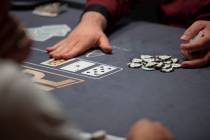
    Doyle Brunson plays a hand during the first day of the World Series of Poker special 40th annual No-Limit Hold'em $40,000 Tournament at the Rio in May. » Buy this photo

By A.D. HOPKINS
LAS VEGAS REVIEW-JOURNAL
Posted: Jan. 17, 2010 | 10:00 p.m.
Updated: Apr. 10, 2012 | 10:38 a.m.

Doyle Brunson has been the central personality of professional poker for more than 30 years and has just published perhaps the most worthwhile autobiography ever written by a poker pro. "The Godfather of Poker" delivers a clear picture of its interesting and paradoxical author.

But it's also a connoisseur's collection of great poker stories, entertaining on first glance and insightful on second. It demonstrates the psychology of devoted players and the codes by which they live. And it's a reliable history of the game's past five decades, and the men who shaped its course, told by one who was on center stage, or near it, the whole time.

Brunson grew up on a cotton farm in Texas and was an outstanding high school and college athlete, expecting to make a career in basketball, when a summer-job injury ended his chances of competing professionally. So he concentrated on his studies, earning a master's degree in administrative education and business administration, with an unofficial minor in poker.

Later, he took a job selling Burroughs' business machines. While trying to sell a cash register to a pool hall, he found a game in the back room. "I sat in and cleared a month's salary in less than three hours," wrote Brunson. "I didn't need one of Burroughs' machines to tell me those numbers didn't add up. So I quit."

Brunson served his gambling apprenticeship on Fort Worth's north side, where players' day jobs often were burglary, dope dealing and bank robbery. One game of ace-to-five lowball ran four days without sleep. Brunson was drinking gallons of coffee but already had developed a dislike for drugs. A guy named Virgil, however, was dropping pills, chain smoking and drinking hard. Virgil bet all his money and Brunson called. Virgil turned over a hand that beat Brunson's.

"Virgil took a drink of Old Charter (whiskey), reached for the pot, and dropped dead on the spot," Brunson wrote. "That's when I found out how cold-blooded poker players can be. All of us had known Virgil. ... After the paramedics took him away, the game resumed, and we played another twenty-four hours."

As a Texan, Brunson tends to illustrate any abstract point, such as the coldness of poker players in the clutch of the game, with a tale.

Some of the best are about his buddy, the late Jack Straus. One was set in the 1982 World Series of Poker: "Straus had pushed all his chips into the middle on a bluff, got called and lost the pot. As Straus was leaving the table, the dealer called out to him and pointed ... there was a chip wedged between the table and the rail that belonged to Jack. Since he hadn't announced all-in, that chip was live -- it wasn't considered part of the pot. So Jack sat back down, won several hands in a row, and parlayed that single chip all the way to the championship. That incident gave birth to the poker saying 'A chip and a chair.' ... Meaning, you always have a chance if you've got any chips at all and are still in the tournament."

And he tells the story of Archie Karas. In 1993, "Archie took a single $100 bill and won 30-something million dollars with it -- then lost it all back." It's a long story, but one of its minor points illustrates the kind of man who could do that. Brunson was playing Karas at seven-card stud with a minimum bet of $10,000. "Boy, that's high! ... It was like the two of us were betting houses back and forth. By the time a hand got to seventh street, it was like we had a whole row of houses lined up in the pot." Brunson made a full house on that seventh card and bet again.

Karas turned his cards over and admitted defeat. "All he had was just two sixes!" Brunson wrote. "No sane player would have seen that kind of action all the way through with those cards."

Brunson is a man of paradoxes. He's known simultaneously for "alligator blood" -- the willingness to wrest an opponent's last dollar from him at the poker table -- and for being a soft touch who might loan $10,000 to the same guy.

Not the least of the paradoxes is his religious faith. Reared in the Baptist Belt, where cardplaying for profit was thought to violate some Commandment or another, Brunson was clearly a backslider. Yet he married Louise Carter, a religious woman, and in 1982, after the unexpected death of their beloved daughter, Doyla, Brunson turned his attention to God. He organized Bible study classes that drew high-stakes players away from big games. He built a Christian television station and even helped fund an archaeological expedition seeking Noah's ark. Along the way he became a student of the Scriptures, but never did find any verse that prohibits cardplaying.

Most of his business ventures were unsuccessful, kept afloat by his skill at poker. Yet, in the difficult field of book publishing, he was fairly successful.

Disclosure is in order, even if it sounds like bragging. About 30 years ago, I played a minor part in helping Brunson write his first book, "How I Made Over $1 Million Playing Poker." In that first effort, Brunson not only revealed his own playing methods but some employed by five other masters: Bobby Baldwin, "Crazy" Mike Caro, Joey Hawthorne, David "Chip" Reese and Dave Sklansky, who authored sections on the games they played best.

Unlike other famous players who used ghostwriters, Brunson and each of his buddies either personally wrote every word attributed to him, or personally edited it. The book sold for $100 and was considered worth it; some experts call it the first really good book on poker.

He took similar pains in writing the autobiography eventually named "The Godfather of Poker," collaborating over five years with Mike Cochran, a respected Texas journalist who had known Doyle since their college days.

By the time he finished the job, Las Vegas-based Cardoza Publishing Co. had acquired rights to Brunson's first book, which was retitled as "Doyle Brunson's Super System," and was selling it in paperback for $29.95. Cardoza became the original publisher of "Super System 2," a sequel with additional authors discussing newer games, and three other books by Brunson.

Publisher Avery Cardoza is thought to have published more gambling books than anybody else in the world but counts the latest Brunson book as only his third biography.

"I wanted to do it because it would be a landmark book about one of the most interesting men of the century, a link to the bygone days of wild west poker," said Cardoza. "The story of modern poker pretty much follows the story of Doyle Brunson. He was important to the World Series of Poker; he was important to online poker. In fact, if Doyle didn't get born, modern poker doesn't happen."

And the story's still not finished, continuing in the Bellagio cardroom, where Brunson regularly takes on all comers at games with a $2,000 minimum bet and a $4,000 maximum. "But that's only because the economy's gone bad," he said. "It was $4,000 and $8,000."

Brunson thinks he may have already played longer at the highest level than any person alive or dead. "Johnny Moss is the only one I can think of who may have done it longer, but he started losing his touch when he was about 70, and here I am 77. I'll keep on playing as long as I can win, and if I can't win at that level I'll go find a lower game and see how I do there."

Contact A.D. Hopkins at adhopkins@reviewjournal.com or 702-383-0270.

Comments

Registration Notice: The Review-Journal has implemented a new registration procedure that requires all existing and new accounts to validate and login using Facebook. Visit the Registration FAQ for more information.
Terms & Conditions

The following comments are provided by readers and are the sole responsiblity of the authors. The Review-Journal does not review comments before publication nor guarantee their accuracy. By publishing a comment here you agree to abide by the comment policy. If you see a comment that violates the policy, please use the Report Abuse button.

Some comments may not display immediately due to an automatic filter. These comments will be reviewed within 24 hours. Please do not submit a comment more than once.

Note: Comments made by reporters and editors of the Las Vegas Review-Journal are presented with a yellow background.

  1. Tom.Jackson Jan. 20, 2010 | 3:49 p.m. Report Abuse

    Does he write about how cheap he is. He is the worst tipper in town. You don't beleive me, ask any poker dealer at the Belagio. Stu the Kid through $100 dollar bills all around town.

  2. just another brick in the wall Jan. 17, 2010 | 7:58 a.m. Report Abuse

    I'm glad that Johnny Moss was finally mentioned. He was one of my favorites among the inner circle of hardened players. The only copy of Poker Player that I ever saved was the one with old man Moss on the cover.

    I think he was losing it at the end due to personal problems, such as his wife VErgie who had to be put into a home because she was suffering from Alzheimer's. As cold blooded as Moss himself could be when he played poker, I believe his wife's condition had an effect on him as well as his own symptoms of dementia.

    Stu Unger was also a very impressive player albeit he had a bad coke habit which, as rumor has it, played a major part in his eventual demise. Sur Unger possessed sang froide in spades. I never saw him bat an eyelash no matter how high the stakes. He was a great, great player.

    It is true, Doyle is one of the least offensive of the players, but the majority of them were boorish, ill mannered louts. I am surprised that they have been able to put them on t.v. but then it is a different generation. Most of the newer players are somewhat educated, at least beyond the 3rd grade, and did not grow up dirt poor.

    One thing is for sure, they odn't make them like Doyle, Johnny, or Unger any more. Those guys came up when men could more or less invent themselves. There was no sensitivity training or dependence upon anything other than oneself. It was a time when men pulled themselves up by their own boot straps -- kind of like forging steel --kind of like JOhnny Moss.

Thursday, May 24, 2012
Overcast Overcast, 88° Weather Forecast