Home subscribe manage Las Vegas Review-Journal
  Jobs Cars Homes Shopping Travel Weddings Golf Best of Las Vegas Photo   Search:

RECENT EDITIONS
Wed Thu Fri Sat Sun Mon Tue

News


New owners safeguarding Moapa dace

Fish at home at Warm Springs Ranch

MOAPA -- A finger-length fish with a black spot in the middle of its tail darts among sunlit bubbles in the spring-fed current of a small stream.

He doesn't know it, but this endangered little guy has some powerful friends.

Newsvine Digg Fark Technorati reddit StumbleUpon del.icio.us Slashdot Propeller Mixx Furl Twitter MySpace Facebook Google Bookmarks Yahoo! Bookmarks Windows Live Favorites Ask MyStuff myAOL Favorites

Most Popular Stories
  • Alleging fraud, authorities raid voter group
  • NORM: Simpson planned acquittal party
  • Nevada's economy dead last
  • NORM: Hard-core fans ask: Has Jacko moved?
  • NORM: Emeril stirring up new LV sports bar
  • NORM: 13th Agassi slam another big hit
  • NORM: Letterman gives an 'A' to O.J. jury
  • 'REALLY, REALLY CLOSE': Obama edges McCain in poll
  • Circle of friends surrounds lost pal
  • The Biggest loser


  • Between the Southern Nevada Water Authority and the U.S. Fish and Wildlife Service, nearly every inch of the Moapa dace's natural habitat is now in the hands of people dedicated to keeping the fish alive.

    The water authority holds the largest piece, a roughly 2,000-acre tract dotted with natural springs and imported palm trees that researchers believe is home to about 90 percent of all the dace on Earth.

    The authority took control of the property known as Warm Springs Ranch, 60 miles north of Las Vegas, in September. The name has since been changed to Warm Springs Natural Area to reflect its new role as a haven for dace and other sensitive species.

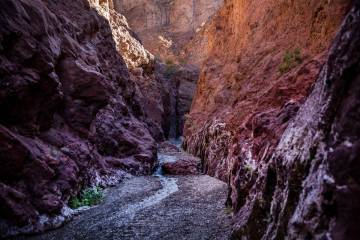
    Prehistoric water from the deep carbonate aquifer bubbles to the surface at dozens of locations on the property, creating small streams that come together to form the Muddy River.

    The Moapa dace spawns in the warm spring pools and makes its home in the streams and upper reaches of the river's main stem. The dace's entire habitat is confined to an area just a few miles long, so even a minor threat could prove fatal to the species.

    The authority eventually plans to develop a comprehensive management plan for the Warm Springs Natural Area. First, though, officials must take stock of their new property.

    Janet Monaco, who heads the authority's Muddy and Virgin River Division, said a complete inventory is in the works for the 1,179-acre ranch. The results could be interesting, considering the land was once owned by Howard Hughes and includes a bath house, a large, spring-fed swimming pool with its own paddle boats, and some cabanas rumored to have been used as an all-nude tanning spot for Las Vegas showgirls.

    Much of that stuff likely will be removed from the property in an effort to return it to its natural state, Monaco said.

    Cattle grazing on the property also are expected to disappear once the current ranching lease expires in March.

    Monaco said the management plan will spell out specific actions, but the overall goal is to create the best possible habitat for the dace and other sensitive species of fish, birds and insects.

    A hint of how that might be done can be found across the road from the natural area at the Moapa Valley National Wildlife Refuge, a federal preserve originally established on 32 acres in 1979.

    The refuge now includes 117 acres of old ranch and RV park property that the Fish and Wildlife Service manages as part of the 1.6 million acre Desert National Wildlife Refuge Complex in Clark, Lincoln and Nye counties.

    Refuge officials have spent the past several years tearing out swimming pools and thinning crowded stands of palm trees that, left unchecked, can choke streams and invite damaging wildfires.

    The tree removal has proven somewhat controversial.

    Monaco said one local resident complained that her view was spoiled when several hundred palm trees were cleared from refuge land across the road from her home.

    Others have argued that the trees are a distinct variety of palm that evolved in North America and came to the Warm Springs area naturally. As such, they deserve to be protected just as much as the dace does.

    Cynthia Martinez, who manages the Desert National Wildlife Refuge Complex, said there are no plans to eliminate the palm trees altogether. Some large groves will be left to preserve the character of the area and maintain roosting areas for bats that have taken a liking to the trees.

    Wildlife managers also are hard at work eliminating non-native fish species that can crowd out the dace or worse.

    In the early 1990s, tilapia, a non-native game fish, found its way up the Muddy River and began feeding on the natives. The dace population plunged from about 3,400 to fewer than 1,000 in just a few years.

    Those numbers are on the way back up. As of the last official count, by researchers in February, 1,172 Moapa dace were living at the headwaters of the Muddy River.

    So far, there have been few opportunities for the average taxpayer to see the work being done on the dace's behalf.

    Martinez said the Moapa Valley refuge has no full-time staff and is closed to the public.

    An effort is under way to clean up the property and construct facilities for visitors, but work has been hampered by a lack of funds.

    "It's kind of been a work in progress," said Martinez, who wouldn't predict when the refuge might open.

    When it does, visitors will be treated to an incomparable look at the dace in its natural habitat. The Fish and Wildlife Service has constructed a windowed cross-section of a spring-fed stream so people can watch the endangered fish swim at close range.

    "I would like to have it open yesterday," Martinez said of the viewing area.

    Eventually, Monaco also expects to see some public facilities within the Warm Springs Natural Area, including some birding trails, but visitor access likely will be limited to protect the dace.

    The property was purchased with nearly $69 million in grants from the Southern Nevada Public Lands Management Act, which uses proceeds from the sale of federal land in the Las Vegas Valley to fund conservation and recreation activities in the region.

    The water authority began taking a lead role in the protection of the dace as part of a 2006 federal agreement with water users in the area.

    The deal cleared the authority to begin tapping the nearby Coyote Spring Valley, where the agency has rights to enough water to supply about 20,000 Las Vegas Valley homes.

    In 2002, the state water engineer put a hold on all pending applications for water rights in Coyote Spring Valley and ordered a two-year test pumping program to determine how much water development the basin could support.

    In the next few months, the authority will start work on a 15-mile pipeline to carry water from the pumping test to the Muddy River. Because the river empties into Lake Mead, the authority can then recover that water -- along with other rights it holds along the Muddy's drainage -- using its existing intakes at the lake.

    The authority's holdings on the river include water leased from the Church of Jesus Christ of Latter-day Saints in 2006. The Mormon church once owned much of Warm Springs Ranch and still maintains a private, 72-acre recreation area for its followers.

    Nevada Power Co. also uses water from the Warm Springs area for its Reid-Gardner power plant in nearby Moapa.

    The recovery effort for the Moapa dace is being watched closely by environmentalists. Some view it as a test case for how the needs of sensitive species will be balanced against the growing thirst for water in the Las Vegas Valley.

    The Moapa dace is expected to remain under federal protection until at least 75 percent of its historical habitat has been restored and its population is holding steady at least 6,000 adult fish. To reach that goal could take years and cost millions of dollars.

    So why all this effort to save an isolated fish barely big enough to make a decent pizza topping? For one thing, federal law requires it.

    "And the fish were here before us," Monaco said.

    To Martinez, the better question is, Why not?

    "They tell us a lot about our natural environment," she said of the dace. "They can be indicators to changes that could effect people."

    And to dismiss an entire species, even a seemingly minor one, seems like an invitation to disaster, Martinez said.

    "How many rivets can you remove from an airplane before the wing falls off?"

    Contact reporter Henry Brean at hbrean@reviewjournal.com or (702) 383-0350.


    Leave Your Comment 5 Reader Comments
    Terms & Conditions
    The following comments are provided by readers and are the sole responsiblity of the authors. The reviewjournal.com does not review comments before publication nor guarantee their accuracy. By publishing a comment here you agree to abide by the comment policy. If you see a comment that violates the policy, please notify the web editor.

    Some comments may not display immediately due to an automatic filter. These comments will be reviewed within 48 hours. Please do not submit a comment more than once.
    Current Word Count:

    sm wrote on January 02, 2008 06:40 PM: they take our land sales buy up property lock us out let another federal agency that needs sent packing with the B.L.M.. Then comes up with another endangered specie(can we adopt this endangered specie like the desert tortoise)will this ever end, no not as long as we the tax payers have deep pockets.


    Vegas Vic wrote on January 02, 2008 03:33 PM: Here's another "program" that's going to be wanting state funds at a time when Gibbons is asking for cuts across the board. As for crazy politicians, that's pretty much a given, especially when something involves the tree huggers. Politicians will fall all over themselves to try to show that they're "environmentally friendly" to get the tree hugger votes.


    tim wrote on January 02, 2008 12:11 PM: i cant wait till the so.nv.water authority starts draining it for the building more homes. its amazing,the tree huggers get the land and start ripping out trees,huh. another waste of our money, no questions asked!


    Waylon Jackson wrote on January 02, 2008 07:01 AM: I am very familiar with the area. No one goes there. This is a huge waste of tax payer money and is so idiotic it is hard to believe. We are spending millions of dollars to protect a three inch fish that prior to this article, no one knew existed. This reminds me of the multi million dollar fence installed on route 160 in Pahrump to protect the desert tortoise from crossing the road. I have been traveling that road for 36 years and have never seen a turtle crossing it. Our politicians are absolutely crazy and nuts.


    Jeremy wrote on January 02, 2008 06:02 AM: This is ridiculus, another so called "endangered species", come on people. Cloning has existed for years now and therefore the endangered species act should be removed, but the environmentalists wont like that as it would put them out of business and they would have to find real jobs.