Home subscribe manage Las Vegas Review-Journal
  Jobs Cars Homes Shopping Travel Weddings Golf Best of Las Vegas Photo   Search:

RECENT EDITIONS
Wed Thu Fri Sat Sun Mon Tue

News


The battle of the bulge

Treatments to melt away fat under the skin offer hope, but sometimes at too high a price

Brazil has banned it.

Kansas tried to last year.

Newsvine Digg Fark Technorati reddit StumbleUpon del.icio.us Slashdot Propeller Mixx Furl Twitter MySpace Facebook Google Bookmarks Yahoo! Bookmarks Windows Live Favorites Ask MyStuff myAOL Favorites

Most Popular Stories
  • NORM: Phelps galpal gets exposure on Web
  • NORM: Robin Gibb in airport standoff
  • NORM: Web site shows life of Mazzeo
  • NORM: Britney-LV buzz hard to nail down
  • NORM: Wynn coveted cathedral's land
  • DOUG ELFMAN: Comedian says his arrest a joke
  • Las Vegas police use saturation strategy to cool 'hot spots' of crime
  • 2-year-old boy dies in dog attack
  • Fresh-faced trio wows throng of youthful fans at MGM Grand
  • DOUG ELFMAN: Cab, limo drivers take pulse of tourists


  • Nevada and other states are exploring their options.

    The issue is cosmetic injections, most notably lipodissolve, which in recent months has raised its profile with heavy advertising and the bankruptcy of one prominent company.

    In Nevada, a legislative subcommittee formed to study the use of such drugs and what, if any, oversight should be established to ensure safety.

    Lipodissolve, a popular nonsurgical alternative to liposuction, is being used widely for weight loss even though the federal Food and Drug Administration has not given it the OK. Physicians using the injections say they are safe and effective. Those who disagree are calling for some proof and urge patients to think twice before paying thousands for an unproven procedure.

    "There's just anecdotal comments where patients say they are happy with the results, but for every one person I see who is happy, there is at least one person who is not," said Dr. Benjamin Rodriguez, a Las Vegas plastic surgeon. "I only see the bad stuff, though. People come to me because of complications.

    "It can be disfiguring and crippling."

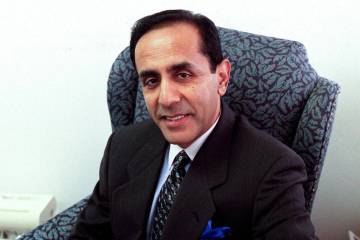
    Dr. Ivan Goldsmith, an internal medicine physician who operates three medical centers in Las Vegas that offer several cosmetic treatments, injects his patients with a drug that melts away fat. The cocktail has ingredients in common with lipodissolve, primarily phosphatidylcoline or PPC, and it operates on the same principle. But it shouldn't be confused with the procedure advertised as lipodissolve by other companies, he notes.

    What Goldsmith offers is commonly referred to as mesotherapy, which also involves direct injections into the body; it too is not approved by the FDA.

    "All we're trying to do is get rid of fat cells, because people should not look like apples, they should look like pears," said Goldsmith, who says he has lost more than 40 pounds through mesotherapy. At Goldsmith's centers, mesotherapy is used in the treatment of cellulite and other skin conditions.

    "Injecting an active fat-eating ingredient less than two inches into the skin is doing a lot of good for people. ... The Europeans have been using this for 50 years," he said.

    Rodriguez, who calls lipodissolve a form of mesotherapy, said he has treated several patients in recent years who have had complications such as swelling, hard lumps and hyperpigmentation, or dark spots.

    Although the swelling can be a nuisance, Rodriguez said, he doesn't consider it as big an issue as the formation of lumps and dark spots.

    Those can be permanent, he said.

    "There's really no options for them after that,'' said Rodriguez, who is a member of the state's Board of Medical Examiners. "What we need to know is if this (lipodissolve) has any therapeutic value, (or) if people are doing it just to make money and are taking customers for a ride. I think the latter ... has more weight."

    Rodriguez said mesotherapy has been practiced in the United States for at least five years, and its effectiveness in getting rid of fat cells has not been proved.

    Lipodissolve is a series of injections given at specific areas such as the chin, stomach or thighs. The theory is that once fat cells are killed, the dead cells are naturally secreted from the body.

    Goldsmith said some companies, such as FIG, which provided lipodissolve, have given mesotherapy a bad rap. That's because their physicians charged thousands of dollars for injections each session when the supplies to make the fat-eating drug cost less than $100.

    Treatments at Goldsmith's office cost about $250 to $300 per 10-minute session.

    Missouri-based FIG, also known as Go FIG or Advanced LipoDissolve, filed for Chapter 11 bankruptcy in late December. FIG operated two locations in Las Vegas, which recently were closed.

    Rodriguez wants all such treatments that aren't standardized to have some oversight.

    He said there also needs to be oversight of who is providing the treatments.

    "That's been a bit of frustration for me as a board member because we are responsible for what physicians do," he said. "If you have somebody injecting something like lipodissolve without a physician overseeing the process, then they are practicing medicine without a physician's license."

    Lynnette Daniels, chief of licensing for the medical board, said the regulatory body was asked by the state's Legislative Committee on Health Care to take part in an overall study of ophthalmology, dermatology, cosmetics and the medical spa industry.

    The study is supposed to take six months and will include considering the creation of special professional licenses to perform certain procedures, standardizing treatments and any other issues related to those topics, she said.

    "The board is very concerned about the medical spa industry, including the use of lipodissolve and botox,'' Daniels said.

    The committee also has set up the Subcommittee of the Legislative Committee on Health Care to Review the Laws and Regulations Governing Providers of Health Care, the Use of Lasers and Intense Pulsed Light Therapy, and the Use of Injections of Cosmetic Substances.

    The subcommittee met for the first time this month and plans to discuss cosmetic issues during its third or fourth meeting.

    Recently, Larry Pinson, executive director of the Nevada State Pharmacy Board, was asked to contact other states about how they regulate lipodissolve. Pinson learned that Kansas' medical board had banned the drug.

    However, the ban was later overturned by a judge after a physician challenged the board's decision.

    Kansas' medical board does require patients to be given an examination before undergoing lipodissolve injections, and physicians must disclose any known side effects, Pinson said.

    Goldsmith said, "If people would just walk, or exercise and eat right, we wouldn't need this, but the reality is that doesn't happen. Fat is very dangerous. It can lead to a lot of chronic diseases, and if it isn't going away, we have to suck it out or blast it, as long as it is done reasonably."

    Goldsmith's physician, Dr. Jill Oliver, agreed.

    The bottom line, she said, is that people still need to eat right and exercise.

    "It's not a miracle,'' she said, referring to mesotherapy.

    "It's not going to take your spare tire away in one treatment."

    Contact reporter Annette Wells at awells @reviewjournal.com or (702) 383-0283.


    Leave Your Comment 1 Reader Comments
    Terms & Conditions
    The following comments are provided by readers and are the sole responsiblity of the authors. The reviewjournal.com does not review comments before publication nor guarantee their accuracy. By publishing a comment here you agree to abide by the comment policy. If you see a comment that violates the policy, please notify the web editor.

    Some comments may not display immediately due to an automatic filter. These comments will be reviewed within 48 hours. Please do not submit a comment more than once.
    Current Word Count:

    former fig. employee wrote on January 20, 2008 11:11 AM: It is inaccurate to say "their physicians charged thousands of dollars for injections each session when the supplies to make the fat-eating drug cost less than $100."

    The treatments were sold in packages for up to 9 treatments (sessions), and that total added up to be the package price that was about $2200 for a single area (depending on the area).

    Interestingly enough, if you go by the other statement in the article that says "Treatments at Goldsmith's office cost about $250 to $300 per 10-minute session", 9 of those treatments at $250 each would be "thousands of dollars" too ($2250).

    I am merely attempting to point out that it sounds like you are trying to paint the picture that fig. was grossly overcharging patients, whereas mesotherapy treatments are so much more economical, when that isn't necessarily true.

    Thanks for your time.