Home subscribe manage Las Vegas Review-Journal
  Jobs Cars Homes Shopping Travel Weddings Golf Best of Las Vegas Photo   Search:

RECENT EDITIONS
Tue Wed Thu Fri Sat Sun Mon

News


Coming to Lake Mead: MX well groundwater


In 1979, the U.S. military began work on a short-lived scheme to hide a mobile arsenal of nuclear missiles in the Nevada desert.

The MX missile project quickly collapsed under the weight of its own cost and scale, but not before hundreds of exploratory wells had been drilled across the region in search of water for the effort.

Newsvine Digg Fark Technorati reddit StumbleUpon del.icio.us Slashdot Propeller Mixx Furl Twitter MySpace Facebook Google Bookmarks Yahoo! Bookmarks Windows Live Favorites Ask MyStuff myAOL Favorites

Most Popular Stories
  • Alleging fraud, authorities raid voter group
  • NORM: Simpson planned acquittal party
  • Nevada's economy dead last
  • NORM: Hard-core fans ask: Has Jacko moved?
  • NORM: Bobbitt trains for boxing bout in LV
  • NORM: Letterman gives an 'A' to O.J. jury
  • Judge: Attacker 'gleeful'
  • PALACE STATION ROBBERY: Audiotapes convicted O.J.
  • NORM: 13th Agassi slam another big hit
  • Circle of friends surrounds lost pal


  • Now these Cold War relics have become key components of the Southern Nevada Water Authority's plan to tap groundwater across the eastern part of the state.

    The authority has teamed with the U.S. Geological Survey and Nevada Division of Water Resources to take periodic measurements from about 40 MX wells.

    A few of the holes have been fitted with equipment to monitor them continuously.

    The authority is using data from the old wells as it presses for federal and state permission to build a massive pipeline network into rural areas of Clark, Lincoln and White Pine counties.

    Last week's state hearing on the Lincoln County portion of the water project included groundwater readings made possible by the MX project.

    So did a 2006 hearing on the authority's plans in White Pine County's Spring Valley.

    "I think it's cool. No data goes to waste," said Jeff Johnson, division manager for the authority's surface water resources department.

    The notion is reminiscent of a certain Bible passage about beating swords into plowshares. But many rural residents don't see much difference between nuclear missiles and SNWA pipelines; to them, both look like attempts to exploit their quiet corner of the state.

    "There is a strong sense of powerlessness," said Louis Benezet, who lives in the mountains east of Pioche.

    On Feb. 8, he spoke out against the water authority's pipeline plan during a public input session held as part of the most recent state hearing on that project.

    Benezet's family roots in Lincoln County date back to 1910. He became a full-time resident of the county in 1980, just as early work on the MX project was gearing up.

    He said he protested the work back then because it was "indiscriminately tearing up the fragile desert landscape."

    Since then, he and his neighbors have battled against plans for a hazardous waste incinerator in one nearby valley and rail routes in another that one day could carry radioactive cargo to Yucca Mountain.

    "There have always been people who have wanted to put things here that other people won't put up with other places," Benezet said.

    Steve Bradhurst understands the links between the pipeline and MX missile project as well as anyone.

    In 1980, Nevada Gov. Robert List appointed him to head up the state office established to assess the MX project.

    Bradhurst now serves as executive director of the Central Nevada Regional Water Authority, a coalition of eight rural counties launched in 2005 to study and protect water resources in those areas.

    "It's sort of like we're back to the argument we had in '80 and '81 ... when it looked like rural Nevada was going to be a sacrifice area for the rest of the country," he said. "(Now) it looks like rural Nevada is going to be a sacrifice area for growth and development in Southern Nevada.

    "It raises the same principal question: Doesn't this area have a right to a future?"

    Then-President Carter pressed for the MX project, which military planners dreamed up as a way to protect the nation's nuclear missiles from a Soviet first strike.

    The $30 billion plan involved the construction of up to 4,600 underground launch sites and a 200-mile "racetrack" on which rockets mounted horizontally would be shuttled from site to site. With no way to know which site had a missile in it at any given time, the Soviets would be forced to target them all.

    "It was a shell game," Bradhurst said. "The idea was the rest of the country would be able to respond while Nevada and Utah disappeared. We would be the sponge to absorb Russia's nuclear arsenal."

    The project would have affected 35,000 square miles in Nevada and Utah. Its proposed footprint took in seven Nevada counties and drew staunch local opposition.

    "Before Yucca Mountain there was MX," said State Archivist Guy Rocha. "The overwhelming number of Nevadans opposed MX."

    They needn't have worried so much. Carter's plan faded quickly. Ronald Reagan saw to that. Nine months after he was sworn in as president, he announced he was scrapping the plan.

    By then, though, some 219 exploratory wells already had been drilled in 26 Nevada watersheds.

    The U.S. Geological Survey eventually assumed control of the superfluous MX wells, including an especially large one that has proved important to the water authority.

    The hole known as MX-5 is located on the Pahranagat Wash in the Coyote Springs Valley, about 50 miles northeast of Las Vegas. When the Air Force drilled it to a depth of 626 feet in 1981, it produced what Johnson called "an incredible amount of water," nearly 4,000 gallons a minute.

    Then the missile project petered out, and the federal government traded the well and the 42,800 acres surrounding it to defense contractor Aerojet in 1988.

    Eight years later, the company sold the still-vacant land to high-powered Nevada lobbyist Harvey Whittemore.

    In 1998, he persuaded the water authority to buy the well and about half of his water holdings in the Coyote Springs Valley for $25 million, the same amount he is said to have paid for the entire property.

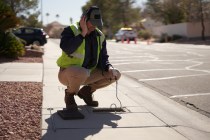
    Today, MX-5 is easy to miss. It's little more than a rust-covered pipe jutting a few feet from the ground just off state Route 168, a few miles east of U.S. Highway 93.

    That will change in the coming weeks, though, when work begins on a 16-mile, $21 million pipeline that will allow the authority to use water from MX-5.

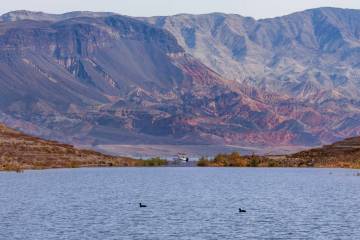
    The water will be treated at the well site for elevated levels of arsenic and piped east to the distribution system for the Moapa Valley Irrigation District. From there, it will flow into the Muddy River and then into Lake Mead, where the authority will capture it using existing intake pipes.

    "We anticipate moving water in late '09, early 2010," Johnson said.

    When that occurs, it will mark the first time groundwater from outside the Las Vegas Valley has flowed from local taps.

    If authority officials have their way, it won't be the last.

    By 2015, they hope to tap billions of gallons of water a year from Eastern Nevada and pump it to Las Vegas through a pipeline that is expected to cost well over $2 billion.

    The authority's case for its pipeline relies on data from the MX wells, particularly in Spring Valley where the agency plans to tap more groundwater than anywhere else.

    The 1 million acre basin in eastern White Pine County is home to 17 monitoring wells from the missile project. Only Railroad Valley in Nye County has more MX wells.

    "These wells are the only view we have into the ground. We need to see as many views as possible," Johnson said. "Anything out there that can be monitored, we're monitoring it. We're leaving no stone unturned."

    Water authority General Manager Pat Mulroy compared her agency's use of the wells to another wartime project that has found a "peaceful application," the water line built from Lake Mead to the chemical plants in Henderson during World War II. That straw continues to supply lake water to Nevada's second largest city.

    The MX project could prove almost as valuable. "Look at all the science we got out of it," Mulroy said.

    "It has also saved the authority a little bit of money because drilling wells isn't cheap," Johnson added.

    Rocha said, "Without taking a position on whether this water importation plan is good, bad or indifferent, I think it is a good use of something. If I was the Southern Nevada Water Authority, I would use this resource."

    Bradhurst agreed.

    "It's a credit to the water authority," he said. "They should be using any information that's available."

    As for which project is worse, the pipeline or the missile array, Bradhurst said it's almost too close to call. Although a swath of land would have been closed off from public access had the MX been constructed, it "wasn't going to take a lot of water out of the ground," he said.

    But as far as Benezet is concerned, the choice between well heads and warheads is no contest.

    "The MX was totally outlandish. It was totally insane," he said. "I don't have anything good to say about the pipeline, but at least I can understand it."

    Contact reporter Henry Brean at hbrean @reviewjournal.com or (702) 383-0350.


    Leave Your Comment 4 Reader Comments
    Terms & Conditions
    The following comments are provided by readers and are the sole responsiblity of the authors. The reviewjournal.com does not review comments before publication nor guarantee their accuracy. By publishing a comment here you agree to abide by the comment policy. If you see a comment that violates the policy, please notify the web editor.

    Some comments may not display immediately due to an automatic filter. These comments will be reviewed within 48 hours. Please do not submit a comment more than once.
    Current Word Count:

    Roger wrote on February 20, 2008 08:46 AM: All of the residents who will be using the water stolen from rural Nevada will be paying for it. Mulroy and her vampires will not say how high water rates will go to pay for that pipeline. That's yet another nail in the coffin for Las Vegas growth.

    Goodman and his mafia buddies can try to kill anybody who disagrees with him, but his city is doomed. By that time his liver will fail anyway...


    TimeRanger wrote on February 18, 2008 10:39 AM: One thing that Mulroy seems to be side-stepping in her advertisements when she talks about a "renewable resource" .... That water may have taken 10s or even hundreds of years to reach that aquifer, depending on the geology of the area.


    WaterSource wrote on February 18, 2008 07:50 AM: Diversions from highly productive wells may cause damage to the water rights of others and/or the environment.

    As an insurance policy, ...just in case there is future damage....NV and the SNWA have been offered a fresh water Source of ONE MILLION acre feet a year.

    Development of the Source has been GUARANTEED not to damage the environment or the water rights of anyone, anywhere !

    Thousands of homeowners will eventually rely upon the wells ! How is Nevada going to tell them to stop using water if diversions from the wells damage the environment or existing water rights ?

    Ray Walker (Retired Water Rights Analyst) waterrdw@yahoo.com


    jj wrote on February 18, 2008 07:40 AM: read our illustrious mayors comment !!!!