Home subscribe manage Las Vegas Review-Journal
  Jobs Cars Homes Shopping Travel Weddings Golf Best of Las Vegas Photo   Search:

RECENT EDITIONS
Tue Wed Thu Fri Sat Sun Mon

News


CORRECTION, 5/29/08 -- In Friday’s Review-Journal, an article about the 2008 Judicial Performance Evaluation incorrectly said the Federalist Society is in favor of judicial appointment over judicial election. The Society recently added a disclaimer to an article on its Web site, “The Case for Judicial Appointments,” clarifying that the article represents only the authors’ view.

Lawyers support appointing judges


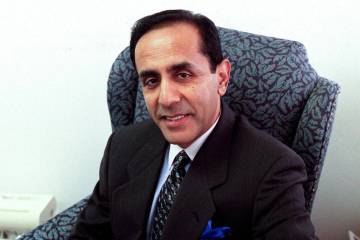
Photo by Jeff Scheid

By a 2-1 ratio, local lawyers favor dumping the election of state judges for a system that appoints judges, according to the Review-Journal's 2008 Judicial Performance Survey.

That's the upshot of one survey question that didn't focus on the foibles of individual judges, but on the limitations of the process by which Nevada culls those who sit in judgment of the rest of us. The survey, done every other year, asks lawyers active in Clark County to anonymously rate judges who work within the county -- on city, justice of the peace or state district court benches -- as well as justices of the Nevada Supreme Court.

Newsvine Digg Fark Technorati reddit StumbleUpon del.icio.us Slashdot Propeller Mixx Furl Twitter MySpace Facebook Google Bookmarks Yahoo! Bookmarks Windows Live Favorites Ask MyStuff myAOL Favorites

Most Popular Stories
  • Alleging fraud, authorities raid voter group
  • NORM: Simpson planned acquittal party
  • Nevada's economy dead last
  • NORM: Hard-core fans ask: Has Jacko moved?
  • NORM: Letterman gives an 'A' to O.J. jury
  • Judge: Attacker 'gleeful'
  • NORM: 13th Agassi slam another big hit
  • Circle of friends surrounds lost pal
  • 'REALLY, REALLY CLOSE': Obama edges McCain in poll
  • The Biggest loser


  • Former Gov. Kenny Guinn, not himself a lawyer, said the result of the question was not startling because he also is inclined toward switching to an appointment method, which would involve extensive vetting of candidates to select finalists. He describes Nevada's system of picking judges as "someone saying, 'I've been a lawyer for a long time, I'm going to run for judge.' "

    "Rule by attorneys" is what some critics have disparagingly called the option of letting a committee or a government executive appoint judges.

    But, appointment advocates volley back that it's the election method that has delivered the present crew of judges in Clark County, some of whom have distinguished themselves negatively in recent years. Judges' actions include taking campaign donations from parties who will appear in court within days before the selfsame judge; getting sued by a clerk for sexual overtures; and being suspended pending resolution of accusations of tainting juries and misusing judicial authority.

    Both extremes came out in written comments by the lawyers who joined the survey.

    "The system we have in place is the best. It allows the citizens of Clark County the opportunity to get rid of judges in elections, as they have clearly done in the past," one pro-elections attorney wrote. Even in an appointment system, the writer added, "All judges will do what they must to be retained, and the committee to appoint the judges will be subject to payoffs."

    For the opposing view, another respondent wrote, "Having the judges raise money to run for election impairs the quality of justice in Nevada. ... Judges should be selected based on merit, not based on their ability to raise money or their desire to hold office."

    A trend appeared among the 796 lawyers who answered the survey question about electing versus appointing judges. Namely, the longer an attorney has practiced law in Nevada, the less eager the attorney is to move from electing to appointing.

    Almost 67 percent of total respondents favored appointment. But in the group of attorneys who are newest to Nevada -- having practiced here five years or less - 72 percent prefer appointing. From there, support for appointing eroded as attorneys gained more Nevada experience. Among attorneys who have practiced here more than 20 years, 61 percent, notably less than among newbies, prefer electing judges.

    Does the Judicial Performance Survey suggest that young bloods, fairly fresh from law school, are simply steeped in the appointment propaganda purveyed by professional legal groups? The American Bar Association, the American Judicature Society and The Federalist Society have all come out in favor of merit selection of judges. Merit selection entails appointment, though the screening process and the party who appoints may vary.

    And, does the recent survey mean that more old coots are content with electing judges because they know how to juice the system for their clients, either with longtime relationships or greater disposable income for campaign contributions?

    Or, do they just doubt that an appointment system would remove politics, which is the owing of favors by bench-holders to the parties that put them in power?

    The United States, too, is divided on the question of electing versus appointing judges. The federal justice system appoints judges for life, barring bad behavior, except in bankruptcy court, where it appoints for lengthy 14-year terms.

    But the states have devised many ways to choose judges for their own courts. Nationally, 77 percent of trial judges must "stand for some form of contestable election," according to the National Center for State Courts.

    Nine states elect candidates to certain courts, but appoint to others, according to the Institute for the Advancement of the American Legal System. Six states have partisan election of judges. Fifteen states, including Nevada, have non-partisan elections.

    Fifteen states maintain commission-based appointments. Three states, California, Maine and New Jersey, let the governor appoint judges. Two, Virginia and South Carolina, let the legislature appoint. Of the states that appoint, three do lifetime appointment.

    But when a Nevada district court develops a vacancy mid-term, then it switches from election to appointment, using a judicial selection commission to come up with candidates, from which the governor appoints one to serve until the winner in the next scheduled election for the post is sworn in. Guinn estimated that during his two administrations, he appointed 20 district judges or Supreme Court justices, for vacancies created by death, retirement, resignation or election to a different court.

    For a state such as Nevada, which theoretically elects judges, Clark County has a lot who arrived on the bench by appointment. A "de facto" appointment system, created by practice, not the state constitution, already exists, some observers say.

    In Clark County District Court today, 12 members have been appointed just since Guinn's first term as governor began in 1999. Data on earlier appointments of present incumbents was not available.

    District court judges who start as appointees seem to do well in the eyes of attorneys who took the recent survey. Nine of the 12 most recent appointees landed in the survey's 25 top judges, as determined by overall retention rating. The survey covered 68 judges and justices in various courts.

    The nine, in order from highest down, are David Barker, Allen Earl, Douglas Herndon, Arthur Ritchie Jr., Jennifer Togliatti, Timothy Williams, Elissa Cadish, Elizabeth Gonzalez and Michael Villani. The three district court appointees who did not make it into the top 25 were Kenneth Cory (rated 36th), Valorie Vega (53rd) and Michelle Leavitt (55th).

    The state Legislature's next session will determine whether a pending proposal to switch to appointing judges advances. Called Senate Joint Resolution 2, the proposal needs to be passed once more by legislators in order to go to a general vote in 2010.

    But Nevada voters have not looked kindly on giving up their right to pick judges, turning down similar ballot questions in 1972 and 1988. Tuan Samahon, on the UNLV law school faculty, wonders whether a future ballot would turn out differently, based on the recent influx of Democrat voter registrations in the state, as well as wave of negative publicity about Nevada judges, including a 2006 series in the Los Angeles Times.

    "I can't say I read the public's mind," said state archivist Guy Rocha, "But what I do see, Nevadans generally want to make that decision themselves. They don't want to leave it to a governor or commission or someone else to do it for them."

    Contact reporter Joan Whitely at jwhitely@reviewjournal.com or 702-383-0268.


    Leave Your Comment 25 Reader Comments
    Terms & Conditions
    The following comments are provided by readers and are the sole responsiblity of the authors. The reviewjournal.com does not review comments before publication nor guarantee their accuracy. By publishing a comment here you agree to abide by the comment policy. If you see a comment that violates the policy, please notify the web editor.

    Some comments may not display immediately due to an automatic filter. These comments will be reviewed within 48 hours. Please do not submit a comment more than once.
    Current Word Count:

    TKC LLC wrote on October 08, 2008 01:39 PM:

    Go to www.ChrisDavisForJudge.com ; he has a FUNNY JibJab style video you have to see! This is your chance to prevent Nevada Courts from further becoming a national soap opera plagued by scandal after scandal.


    Smoky wrote on September 05, 2008 07:11 AM:

    Smoky wrote on September 05, 2008 06:59 AM: OnTheInside wrote on July 27, 2008 06:54 AM: 1990 Judge Mosley hires Landess for girlfriends real estate lawsuit. http://www.latimes.com/news/politics/la-na-vegas8jun08,0,387539.story?page=8&coll=la-headlines-politics

    1993 Judge Mosley rules on cases for Landess' son Justin
    http://www.lvrj.com/news/19245844.html

    Today, Mosley's rulings are buried in Blackstone so as not to expose Mosley's involvement.
    District Case Inquiry - Minutes

    Case 03-C-191619-C Just Ct. Case# 03-F -06394 Status CLOSED
    Plaintiff State of Nevada Attorney Roger, David J.
    Defendant Landess, Justin T Attorney Public Defender
    Judge Leavitt, Michelle Dept. 12

    --------------------------------------------------------------------------------
    Event 06/25/2003 at 09:00 AM SENTENCING
    Heard By Mosley, Donald M.

    FURTHER ORDERED, Sentence to run CONSECUTIVE to any other sentence and deft. released to P&P only.
    CLERK'S NOTE: 7/31/03 Sentence to run CONSECUTIVE to C190087.

    SEEMS A VOTE FOR LANDESS IS A VOTE FOR MOSLEY YOU DECIDE


    tmosley wrote on May 25, 2008 10:24 AM: To "DUH" While I would not assume you are the idiot, perhaps you might have misunderstood. While I do not hold all attorneys in the highest regard, they are the best resource we have for input in a judicial survey. If you have any other positive suggestions which would help the voters understand better what occurs within the walls of the RJC daily, then by all means, please offer a solution opposed to further insults and representations of what won't work.


    DUH wrote on May 25, 2008 09:18 AM: TMOSLEY, you are an IDIOT!
    Attorneys have no place opining the JUDGES application of LAW, other than to appeal their case to the NEVADA SUPREME COURT, or THE UNITED STSTES SUPREME COURT!


    ALICE wrote on May 25, 2008 09:12 AM: OH.... GREAT NANNY STATE,
    PLEASE TAKE AWAY MY POWERS TO VOTE!
    I AM UNWORTHY, AND UNINFORMED!


    tmosley wrote on May 24, 2008 04:04 PM: Attorney's are best able to recognize when a judge is violating judicial canons, court rules, and the laws. Those same attorneys appear before these judges on a daily basis. For obvious reasons they are the most likely target group to evaluate our judiciary. The attorney's then have a duty as an officer of the court to make violations known in order to preserve the integrity of the judiciary. That's where the problem begins. I have been on both side of Nevada's Political Fence, and if anyone believes that the judges do not ban together to protect their own as well as intimidate, sanction, and professionally harm certain attorneys, that is naive. Injustices occur every day for many reasons. Most attorneys would rather say nothing than subject themselves to retribution, even at the expense of their clients. Having said that, there are also attorneys who live for the days when they can walk into a courtroom, present their case, know without a doubt that they are on a level playing field, and realize justice for their client. The attorney doesn't expect to win every time, just as disgruntled litigants shouldn't. What they should expect is that when they walk into the courtroom the judge has not previously engage in ex-parte conversations. There are judges, who take pride in not being part of the "fraternity" and truly have a respect for the law. Perhaps we should consider how offended certain judges become at the deceptive tactics so frequently used by some attorneys in their courts. It is impossible to generalize, yet it appears more attorneys and more judges are less comfortable with judicial violations and may even silently hope the voters exercise their constitutional rights.


    It is a shame wrote on May 24, 2008 01:53 PM: It is a shame that those who have watched and experienced judicial corruption don't ban together and demand that something be done.

    Laws need to be followed. And strict laws need to be enacted to guarantee corrupt judges do jail time and make restitution to those the have hurt.


    tmosley wrote on May 24, 2008 08:16 AM: To Glenn: Absolutely. Obviously what we have is not working for the very reasons you articulate. I would much rather modify the "Missouri Plan" and allow the people to evaluate and remove any judge more frequently, perhaps every two years. The initial appointment does not need to be made by attorneys exclusively and there is no reason "hearing confirmations" or the like could not be public. It is the secrecy involved within the judicial system that threatens our constitutional rights. For the past fifteen years I have watched and experienced judicial corruption and only now realize it is not only my right but my duty to enlighten those who wish to be.


    Glenn wrote on May 24, 2008 12:13 AM: The only problem with electing judges is an electorate that stubbornly refuses to educate itself about its elected officials and their duties to a level required to maintain a competent democracy. So, the citizens, most never having any dealings before the various courts (other than traffic) vote for names the recognize (i.e., incumbents who get some publicity in the press and those with similarly recognizable names like Joe Boneventure, Jr.).

    If our citizens will not take the time to educate themselves about the real issues in a Presidential race........what hope do we have for the rest.

    But, at least the election and recall process, gives our citizenry a chance to get rid of the most aggregious and well publicized offenders. Better than this history of our Judicial Discipline Committees.


    To Jem wrote on May 23, 2008 06:16 PM:

    "Too often the governor's appointments reflect political expediency instead of merit."

    Jem: Give us some proof.


    Read All Comments