Quantcast
Home manage Las Vegas Review-Journal
  Jobs Cars Homes Shopping Travel Weddings Golf Best of Las Vegas Photo   Search:

RECENT EDITIONS
Wed Thu Fri Sat Sun Mon Tue

sponsored by
News


CORRECTION ON 06-19-08 -- A map in Wednesday’s Review-Journal misrepresented the boundary between Las Vegas and North Las Vegas. The dividing line between the two cities north of Cheyenne Avenue is Decatur Boulevard.

Las Vegas pushing growth to limits

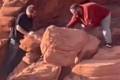
In far northwest Las Vegas, the city ends abruptly. One side of the street has houses and sidewalks, and the other has open space, including an environmentally sensitive area called the Upper Las Vegas Wash.

The city's recent budget woes have thrown the economic implications of that area into sharp relief, because it's one of the few places left for the city of Las Vegas to expand. It's also home to rare plant life, mammoth remains and other valuable fossils.


Most Popular Stories
  • Traffic accident claims life of longtime, successful lawyer
  • NORM: Buchanan called 'larger than life'
  • One motorcyclist killed, another critically injured in accident
  • THE FACES OF JOBLESSNESS: Family had to get help for first time
  • NORM: Marie Osmond, manager battling
  • Nurseries fence out day laborers
  • Second person dies after being restrained by police
  • NORM: Agassi reveals bad vibes with Shields
  • North Las Vegas motorcyclist killed in collision while racing, police say
  • Las Vegas police make arrest in 2008 slaying


  • "If you don't have growth, then it could have a potentially large impact on the growth of (tax) revenue," said John Restrepo, a consultant who has analyzed Las Vegas' finances. "They won't be able to get their fair share of future growth" in Southern Nevada.

    But finances can't be the only consideration on the table, said Jill DeStefano, who is part of a group pushing for conservation in the wash.

    "Everybody's still having children. The population will grow. People still need housing. All we're saying is, there's some acreage that's just too precious to build on."

    Las Vegas is the first of the valley's cities to bump against its geographic growth limits. That will have far-reaching impacts on the city's ability to keep up with expenses and, possibly, the way future development proceeds.

    "I don't think there's any illusions that the city is landlocked," said Jeremy Aguero of Applied Analysis, who has studied growth in Las Vegas. "I don't think there's any other economy you can find that is as dependent on growth as Southern Nevada.

    "When you're dependent on growth and your city is landlocked, it does not bode well."

    It's not all bad news, though. For instance, Las Vegas is taking the right track in trying to redevelop downtown areas, "taking less productive uses and turning them into greater intensity and greater productivity," Aguero said.

    Nor is the city alone, he added: "At some point, the valley's going to be facing the same fate that the city of Las Vegas is showing us today. We're all going to have to deal with that."

    Las Vegas had to reduce spending by $20 million this year because of the economic slump, which depressed collections of the consolidated sales tax, or "c-tax."

    Shortfalls of more than $40 million are expected in the next two budget years, and the city plans to hold positions vacant, trim capital spending and dip into reserves to make up the difference.

    But the long-term picture could be tough as well. The city's chief sources of revenue -- the consolidated sales tax and property taxes -- rely on growth to increase. Those taxes are fed by purchases of homes and furnishings, and the addition of residences to property tax rolls.

    City projections are that the consolidated sales tax, which has been the city's main source of operating revenue, will grow an average 4.5 percent a year through 2013. Overall revenues are expected to grow about 5 percent a year.

    That's lower than the last eight years when, except for a period following the Sept. 11, 2001, terrorist attacks, the c-tax's growth rate alone ranged from 8 percent to nearly 20 percent per quarter.

    Expenses, meanwhile, are expected to eat up that revenue growth. The biggest is the cost of labor, which is projected to rise an average of 6.7 percent per year during that same period, an overall increase of more than $90 million.

    Because Las Vegas is limited in where it can grow, city leaders have endorsed the smallest of six options the Bureau of Land Management put forward for protecting the Upper Las Vegas Wash -- a 2,900-acre conservation area to the north and northwest of the city. The BLM expects to release a draft environmental study next month.

    The largest option would set aside 13,000 acres and would stretch from northern North Las Vegas to the Paiute Reservation.

    Councilman Steve Ross, who represents northwest Las Vegas, said "it would be premature" to discuss land use in the area until a Utah State University environmental impact study is complete.

    "The city believes in protecting the environment while also providing an opportunity for growth," Ross said is a written statement.

    Expanding to the north isn't the only response to tight budgets. City staff has been ordered to review all programs and departments to see what can be cut or eliminated. That report is due later this year.

    City leaders also want to look at reworking the contracts with the various unions that represent city employees so that personnel costs don't expand faster than the city's ability to pay.

    DeStefano noted the oft-stated idea that Las Vegas' best future is to "grow up" instead of out, with people living and working in high-rises.

    "We may have to grow up," she said. "And with the cost of gas, people may want to live where they work."

    Councilman Larry Brown, who is running for the Clark County commission, summed up the city's situation at a recent candidate forum.

    "The days of double-digit revenue growth are over," he said. "We're going to come back. But we're going to come back as a different animal."

    Contact reporter Alan Choate at achoate@reviewjournal.com or 702-229-6435.

    Newsvine Digg Fark Technorati reddit StumbleUpon del.icio.us Slashdot Propeller Mixx Furl Twitter MySpace Facebook Google Bookmarks Yahoo! Bookmarks Windows Live Favorites Ask MyStuff myAOL Favorites

    Leave Your Comment 12 Reader Comments
    Terms & Conditions
    The following comments are provided by readers and are the sole responsiblity of the authors. The reviewjournal.com does not review comments before publication nor guarantee their accuracy. By publishing a comment here you agree to abide by the comment policy. If you see a comment that violates the policy, please notify the web editor.

    Some comments may not display immediately due to an automatic filter. These comments will be reviewed within 48 hours. Please do not submit a comment more than once.
    Current Word Count:

    Note: Comments made by reporters and editors of the Las Vegas Review-Journal are presented with a yellow background.

    Report abuse

    Jason wrote on June 19, 2008 12:36 AM: The water issue comes up again. Why don't we have our "representatives" in Washington DC try to increase our water from the Colorado River. Or how about building an aquaduct from the Mississippi River and others that overflow, that runs into Lake Mead. Doing an aquaduct would solve two problems...flooding in the Mississippi River Valley, and the water shortage in Southern Nevada. True, the idea costs money, but that money that would go to repeated flooding victims, could help pay for the aquaduct.
    I also think that land should be preserved. We have such limited local history here in the valley, why not try to save history that has national or worldwide impact. Much of the nation has history through out, but here in Nevada, history is 50 years.


    Report abuse

    ths wrote on June 18, 2008 07:21 PM: Simple solution vote in new people every 4 years until you find someone that does not take kick backs.


    Report abuse

    Pfffft! wrote on June 18, 2008 02:28 PM: tabitha wrote: "Why do we need 20,000 more track houses sitting vacant because they were foreclosed on?"

    Because our "representatives" haven't gotten enough sweet land deal kickbacks. Hint: They never will get enough.


    Report abuse

    tabitha wrote on June 18, 2008 11:17 AM: I live up in the Northwest and I kind of like all of the open space north of the 215. If there are rare fossils there, they should be left. Why do we need 20,000 more track houses sitting vacant because they were foreclosed on?


    Report abuse

    vc wrote on June 18, 2008 09:45 AM: I have to agree with one of the previous comments. We really need to slow growth due to the lack of water. This valley is big enough already. In 100 years if we keep growing this place will be a ghost town. No water = no people.


    Report abuse

    stop the insanity! wrote on June 18, 2008 09:29 AM: Overdevelopment is one of the factors contributing to the real estate market taking a huge dump in the valley.


    Report abuse

    ths wrote on June 18, 2008 08:20 AM: Who does the councilman represent as many residents out in the NW don't want to see further unmanaged growth. Kyle Canyon Master development is all about packing 15,000 homes on less then 2,000 acres. The city was once again looking at dollars and not the current residents and type of development. Lets stick 15,000 families 25 miles from the employement center.

    Also with growth is more services (Parks, police, street maintenance, public trans and so on) that are required which means more money spent from the budget. Growth is not the only way that budgets should be tackled. That is short sited and we should have smarter leaders then that.

    Boulder city is a perfect example how to manage budgets with controlled growth. Mayor Goodman who I do like, look past that city you don't know Henderson and do please look at Boulder City and learn.


    Report abuse

    Judy wrote on June 18, 2008 08:00 AM: Councilman Steve Ross, who represents northwest Las Vegas, said "it would be premature" to discuss land use in the area until a Utah State University environmental impact study is complete.

    One question: Why is Utah State University conducting the EIS and not UNLV?


    Report abuse

    Tom Atriedes wrote on June 18, 2008 07:37 AM: We may need to change our development model from vast, sprawling tracts to smaller developments. I live in Silverado Ranch, and we still have a ton of undeveloped areas, but they are small one to five acre areas.

    Also, the sooner houses stop being built, the sooner the housing market will turn around.


    Report abuse

    2zero wrote on June 18, 2008 07:08 AM: Boulder City manages to survive and thrive on managed, controlled and limited growth!

    No water, no electricity....no resources!

    Stop the unsustainable growth now!!!!


    Read All Comments