Quantcast
Home manage Las Vegas Review-Journal
  Jobs Cars Homes Shopping Travel Weddings Golf Best of Las Vegas Photo   Search:

RECENT EDITIONS
Wed Thu Fri Sat Sun Mon Tue

sponsored by
News


TOUGH TIMES REMOVE SOME OF THE SHINE

Las Vegas is not just a place where people are born and live. It is an enterprise.

It is a deal people enter, a set of givens agreed upon: More is better. Biggest is best.


Most Popular Stories
  • Traffic accident claims life of longtime, successful lawyer
  • TRAFFIC STOP: Shooting accounts conflict
  • One motorcyclist killed, another critically injured in accident
  • THE FACES OF JOBLESSNESS: Family had to get help for first time
  • NORM: Buchanan called 'larger than life'
  • NORM: Marie Osmond, manager battling
  • Nurseries fence out day laborers
  • Second person dies after being restrained by police
  • REFUSING THEIR OWN MEDICINE: Vaccination policy spurs legal action
  • NORM: Agassi reveals bad vibes with Shields


  • To live in Las Vegas is to stake your future on this enterprise -- for better or worse.

    For the past 20 years, it has been for better. The unemployment rate was minuscule. Gleaming new casinos were built on "old" casinos like so many sandcastles on a beach. Hundreds of neat stucco houses promised a palm tree or a pool or both for nearly everyone with a paycheck.

    In Las Vegas, average people are versed in the statistics that impress relatives from back East and testify to the success of this enterprise: 39 million visitors, almost 140,000 hotel rooms, 10 new schools a year. It was a place that not only believed its own hype, but depended on it.

    And so, it has been a shock as, quietly and slowly, everything has changed.

    Like many U.S. cities, Las Vegas is watching its economy reel. Home values have plummeted. Foreclosures have exploded. Unemployment is the highest it's been in at least 20 years.

    For the first time in decades, the population has stopped growing. Casino projects are on hold. Planes full of free-spending tourists are landing with less frequency. Long the embodiment of American confidence, the city is now in limbo.

    In Las Vegas, the economic mess is also an identity crisis.

    FAME, FORTUNE: ONLY PASSING THINGS

    "Jackpot Town!" the headline read.

    And above it was the smiling face of Jesse Grice. He was just 27, six years into his career as an Elvis impersonator. A young Elvis Presley. A fit, fresh, gold lame Elvis, on the cover of Time Magazine.

    As he tells it now, even then in November 1998, he could not believe his luck. He had loved this town since he was a teenager in Dallas, when his father, a salesman, sold enough Tropicana orange juice to win a trip to Sin City, then returned with tales of the fantasy land in the desert.

    By the time Grice arrived in 1993, the fantasy had grown larger. The Mirage, gambling tycoon Steve Wynn's new beacon of luxury, had changed the definition of casino. The era of attractions, of pyramids and tigers and pirates and mini-European cites, had begun.

    And yet, Grice was stunned to find the Elvis market untapped.

    "I thought I was in heaven, man," he says in a voice that echoes The King's every inflection, only an octave higher. "Fifteen years ago, if you was going to struggle, this was the town to struggle in."

    Grice became a character like the city itself. He held nothing back. He was hungry. He made friends easily and promoted himself with charm. He made lots of money, fast, calling himself Jesse Garon, the name of Elvis' stillborn twin brother. In 1996, Grice bought a Graceland, a 4,000-square-foot rambling ranch house with a squat palm tree out front and a kidney bean-shaped pool in back. He paid an ironworker to re-create the gates of Elvis' Memphis mansion.

    "Las Vegas was beyond good to me," he says.

    After years of seeing his home's value soar, Grice took a gamble, using equity in his house to invest in a downtown bar, hoping for long-term security.

    But the gates of Graceland couldn't keep out a developing national recession.

    As the bar's business slowed and he started to fall behind on mortgage payments, his Graceland began losing value.

    The bank took it back in October. Grice sold his collection of memorabilia on the front lawn. He put the Graceland gates in storage and moved away.

    Now, in a city that's also changed, an older, rounder, jumpsuit-era Elvis sips a midday martini in his condominium. He's upbeat about living more simply, his new beginning, a new wedding chapel venture.

    Still, he now says of the second-chance capital: "I think it's become an unforgiving town. I feel sorry for the fool who comes here to try to make it as an Elvis impersonator or anything else. It's just a tough town all round.

    "Look how many years we were up, up, up, and the ride had to end at some point.

    "Well, it just ended."

    BUSINESS DIPS, WORKERS SUFFER

    Lavana Jackson, mother of six, grandmother of 17, suffers no fools. She peers over the rim of her glasses with a face of sheer disbelief when asked a stupid question.

    "We're feeling it. Oh, we're feeling it," she says.

    Jackson is surrounded by racks of T-shirts piled with coffee mugs, snow globes, baseball caps, shot glasses and novelty license plates.

    Lots of stuff, no one to buy it.

    For the past seven years, Jackson has spent her days among the stuff at Convention Center Souvenirs, south of the Riviera.

    The captains of gambling said a couple of years back that there would be so much new development, no part of the Strip would be left behind.

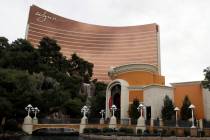
    Wynn threw down the gantlet when he opened his sleek $2.7 billion Wynn Las Vegas in 2005.

    It spurred a new wave of one-upmanship. MGM Mirage announced its $9.2 billion CityCenter project. Las Vegas Sands, owner of The Venetian, spent $1.9 billion on Palazzo.

    Donald Trump built a taller condominium tower. Wynn built another hotel.

    The Cosmopolitan, the Fontainebleau, the Plaza, the billion-dollar projects could easily blur together.

    Today, one piece of the seemingly boundless expansion stands outside Convention Center Souvenirs. It was to be Boyd Gaming's Echelon project. It promised 5,000 rooms in six hotels in a complex that would be lush with landscaping and luxury accommodations. All for a mere $4.8 billion.

    The 50-year-old Stardust casino was imploded to make room, and construction rolled along for more than a year and nearly 12 stories until the credit markets choked. In August, Boyd executives put the enterprise on hold. Nearly 800 construction workers were left to find new work.

    To Jackson it was an outrage.

    On her smoke break, she looks out at seven frozen construction cranes hovering over a massive, slumbering, concrete skeleton. It sits like a stopper on the flow of foot traffic outside the store.

    Her hours have been cut back as business slumps.

    "Our hope was that it would start up again, but look at it. It's just sitting there, rusting. At least when the Stardust was there, we made money," she said.

    The 52-year-old has lived in Las Vegas and worked on the Strip most of her working life. She has moved away and come back. She got married, had children, left her husband and reunited with him. The constant was Las Vegas.

    "In Las Vegas you could always get a job. A woman could take care of her children," she said. "I don't know what happened, but Vegas is really stressed out. People don't understand it and I don't either because Vegas has never been like this."

    A DOWNTURN LIKE NONE OTHER

    College of Southern Nevada history professor Michael Green agrees Las Vegas has never been like this.

    Previous economic dips, one in the late 1990s and another after the terrorist attacks on Sept. 11, 2001, were brief and largely confined to the tourism industry. In a very Las Vegas way, they were forgotten once the money began flowing again.

    This one might be harder to forget.

    The downturn is longer, more pervasive, open-ended. It has devastated not just the tourism industry, but also the state's only other major economic driver, construction and development.

    "This recession destroys the illusion of prosperity," Green says. "And I believe some of our prosperity was an illusion."

    He describes Las Vegas' promise as an inversion of New York City's boast: "If you couldn't make it anywhere, you can make it here."

    But it has long fallen short on that deal for many.

    Southern Nevada social services have struggled to keep pace with need. The state's suicide rate is twice the national rate. The city leads the country in percentage of teenage high school dropouts. It's among the highest in percentage of uninsured.

    The recession is laying bare those shortcomings, Green said. There's no easy money to hide the gaps, no certainty how long the downturn will last, no clear idea what the new Las Vegas will look like.

    "That creates a whole new culture here, I think," Green says, "one that I don't know that we're ready to deal with."

    A PROMISE OF RICHES DENIED

    When times were good, the buzz of a booming Las Vegas was a siren song for all types. Retirees, young families, Californians lured by low taxes, East Coast natives lured by high temperatures. For years, Las Vegas sat near the top of lists of fastest growing cities.

    Growth was a dinner party topic. Did you see that new shopping center opened? Have you been to the new casino?

    Each opening came with jobs. Word traveled.

    It went all the way to Atlantic City, once a Las Vegas rival, where a couple of card dealers, Donald "Butch" Youshaw and his girlfriend, Bernie Jones, heard the call.

    "Come out West. Get a job. They're booming. They're hiring," they remember being told. "Casinos are going up. The housing market is going up."

    In 2002, the couple drove across the country, towing his classic Mercedes Benz. Youshaw, along with his mother, a retired nurse, bought a three-bedroom stucco home. It had a fig tree in back and no stairs, good for his sister, who uses a wheelchair and was expected to join them.

    But casino jobs were harder to get than he anticipated.

    "It's all about who you know," he said.

    He knew no one.

    Still, others seemed to be soaring. His neighbor was gobbling up investment properties as home values headed north. Youshaw imagined he might try his hand at real estate, but first he needed money to spruce up the home he already owned.

    His mother saw an ad on television for a refinancing program. She called the number and got a new loan with ease and little clear explanation.

    But the loan came with hidden fees and higher monthly payments, and Youshaw fell $25,000 in arrears before the bank foreclosed.

    Stunned at how quickly his fortunes turned, Youshaw says, "I'm living like I did when I was 19."

    Today he and Jones spend their days in a home they rent just blocks from the one he lost. Youshaw has pawned jewelry and even took out a payday loan at 200 percent interest to pay the gas bill.

    Jones, who looks far younger than her 51 years, continues to look for casino work, though some have suggested she's just too old to be a cocktail waitress.

    Speaking of Las Vegas now, Youshaw says, "It's not what they say. It's like a show. At the end of the day they roll up everything and take it away. Set's closed. Go.

    "But I'm stuck. They got me here. I can't afford to move."

    TRYING TO GET THE GROOVE BACK

    There are plenty of men and women trying to revive the enterprise: casino executives, public officials, advertising executives.

    Among those is Terry Jicinsky, the senior vice president of marketing for the Las Vegas Convention and Visitors Authority.

    But as smaller numbers of visitors come, off 10 percent in October from a year earlier, the marketers keep adjusting their pitch: casting Las Vegas as an easy last-minute destination, then as affordable, then as an escape for "crazy times."

    But bad times? No one here planned for that.

    "Because our growth cycle has been going on for 20 years, you know, for many people, myself included, that's a career. That is the entire length of your experience," Jicinsky says. "We have casino executives that started working in their 20s and 30s that are now in their 40s and 50s, where all they knew was double-digit growth year after year after year."

    Jicinsky says he doesn't believe "What happens here" is outdated. It will continue to define Las Vegas, he says. "Everyone could see themselves in a Las Vegas story."

    As Jicinsky speaks, the bustle of the convention floor floats into his office. Today's convention, a gambling industry summit, has been full of glum news of frugal gamblers and tightfisted lenders.

    Just now, aspiring bar bands are auditioning for club owners below. A woman's voice intrudes on Jicinsky's thoughts. "Chain, chain, chain ... chain of fools," she sings.

    Newsvine Digg Fark Technorati reddit StumbleUpon del.icio.us Slashdot Propeller Mixx Furl Twitter MySpace Facebook Google Bookmarks Yahoo! Bookmarks Windows Live Favorites Ask MyStuff myAOL Favorites

    Leave Your Comment 27 Reader Comments
    Terms & Conditions
    The following comments are provided by readers and are the sole responsiblity of the authors. The reviewjournal.com does not review comments before publication nor guarantee their accuracy. By publishing a comment here you agree to abide by the comment policy. If you see a comment that violates the policy, please notify the web editor.

    Some comments may not display immediately due to an automatic filter. These comments will be reviewed within 48 hours. Please do not submit a comment more than once.
    Current Word Count:

    Note: Comments made by reporters and editors of the Las Vegas Review-Journal are presented with a yellow background.

    Report abuse

    VegasBob wrote on January 05, 2009 02:27 PM: I worked in gaming and escaped from Vegas in 2006, before the economy fell off the cliff.

    Vegas is a one-horse town - the trouble is that spending on casino entertainment is totally discretionary on the part of the customer.

    During the good times, the casinos ripped off every customer they could - inflated room rates, over-priced food and drinks, and really tight slots.

    Customers caught on quickly enough - I heard plenty of patrons refer to certain casinos as "clip joints."

    Now times are bad, and the customers just stop coming to Vegas. I figure Vegas is getting what it deserves.

    It's just too bad that the gaming CEOs and their minions are foisting off the economic problems on the backs of their workers. The gaming executives won't be suffering economically, and that's a bet you can make with total certainty.


    Report abuse

    Mary Pyra wrote on January 04, 2009 06:57 PM: It's unfortunate how life changes. Alpha/Omega,Beginning and End,What's up must come down, Nothing lasts forever. We're not in control, A higher Being is.Time and patience will be needed now, and all will change again. The power of prayer will help.
    Peace,love,and forgiveness,and caring for your fellow neighbor.Everything must change--Nothing stays the same.


    Report abuse

    WisconsinGambler wrote on January 03, 2009 06:03 PM: And another thing. Even when I play $100 / hand of BJ for 5-6 hours at a time at Treasure Island or Mirage, I can't get a room comp. The casino host always tells me, "oh, you have to average $125 / hand to ge a room comped. What a joke, I am talking about a simple room, not even a suite.


    Report abuse

    VegasPilot wrote on January 03, 2009 11:16 AM: Some great comments - too bad they will all fall on deaf ears.

    I used to live in Southern California and would fly about 6 times a year over to Vegas with friends in small private aircraft. We used to be able to land at McCarran get great service, relax, gamble, see a show, or whatever and fly home Sunday Nite. NO MORE.

    Vegas lost its charm and now that I live here it has lost it even more.

    I brought my private aircraft here and sold it because dealing with the airports is terrible. (Randy Walker's regime has destroyed this infrastructure. Like the Casino's unless your flying in multi-million dollar aircraft (with Whales) you get the feeling you are just not welcome. (I sure did)

    Like many have stated in their comments the Casino make you feel like second class citizens, $5 Blackjack (if you can find them) and often $10 or more. A working stiff just can no longer afford Vegas. The fancy multi million dollar Casino are cool to visit once, but you park in a garage out back and walk miles to get inside. I personally just avoid them. Vegas has lost its charm, egos and arrogance run the city and it is for the worst.

    It would be so nice - if Vegas (the City Government & the Casinos) would read these comments, - stop hiring Ivy League Grads with no experience and NO understanding of what visitors (customers) want. These Ivy leaguers sure did not know what they were doing on Wall Street - what makes you think they know it here. Get a small business owner who has to make ends meet that has to be creative - then maybe it will work.


    Report abuse

    Timmy wrote on January 03, 2009 12:06 AM: The expensive room rates, the table service at the clubs, the raised table minumums are no longer affordable to most people. They really weren't affordable a few years ago either, but you had people taking a equity of of their houses to act like a high roller. Or you had the punks in the mortgage industry who were making too much money coming to Vegas to blow it in partying. Now the equity is gone and those mortgage guys are waiting tables at Chili's.
    I used to come to Vegas from So Cal a few times a year. Every time I came to Vegas it was enjoyable. But also, on EVERY SINGLE TRIP, I received really bad (actually, really, really bad) service. For $300+ per night I expect Ritz Carlton / St. Regis type service. Unless I was throwing around a few hundred a hand, no one went out of their way to provide a good experience.
    To Vegas, I say you are getting what you deserve now.


    Report abuse

    WisconsinGambler wrote on January 02, 2009 09:09 PM: I agree 100% with Mary. I am from Wisconsin and as I have stated in other posts, I have been disgusted with the Las Vegas attitude that everyone wants to pay $250 - $300 a night for a simple double queen room.

    I am not a high roller, but I feel like the 10's of thousands of dollars that my family and friends spend on entertainment (gambling) should be worth something to someone. But the casino's don't agree.

    I miss the Stardust as well. We were always comped there and gladly gave them all of our action while we were in town. The end of the Stardust was the end of an era for visitors such as myself.


    Report abuse

    Stardust wrote on January 02, 2009 08:16 PM: Mary,

    Most of the people who ran the Stardust are at the Orleans. They have great rates and a great place - hope you come back soon!!


    Report abuse

    Mary wrote on January 02, 2009 07:06 PM: My Husband and I have been going to Vegas from Michigan for over 25 years. We are saddened by the so called fancy Casinos.
    All the glitter does not impress us. The Star Dust was our "home away from home".They treated us like family. We knew the "odds"(gambling)were always against us, but the family atmosphere made the trip worthwhile. After it was imploded we tried different Casinos to find the similar feeling. It seems they have "gotten too big for their own britches". We are the middle class that everyone seems to want to eliminate.We worked hard and have retired. We love Vegas, but fell slighted. We don't need anymore "stuff", like they are trying to sell in the big fancy shops. Just give us decent comps. and treat us like your so called whales and we will come back!


    Report abuse

    Mr.Farts wrote on January 02, 2009 06:38 PM: ecomny+farts=MMMMMM


    Report abuse

    No one gets it! wrote on January 02, 2009 05:40 PM: No one seems to realize that Las Vegas is not necessary for survival. The casinos rolled every mark they could. When a convention comes to town the casinos see marks and attempt to roll them through rip off room rates.


    When you find yourself in a hole, quit digging.


    Read All Comments