Home manage Las Vegas Review-Journal
  Jobs Cars Homes Shopping Travel Weddings Golf Best of Las Vegas Photo   Search:

RECENT EDITIONS
Thu Fri Sat Sun Mon Tue Wed

sponsored by
News


PREHISTORIC SIGNS FOUND AT PRESERVE

Radar indicates Anasazi pit houses

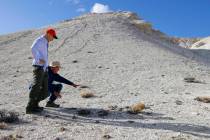
A team of scientists exploring Springs Preserve with remote- sensing gear has found what appears to be a prehistoric village of pit houses where as many as 30 Anasazi people lived about 1,300 years ago, the preserve's archaeologist said Friday.

The discovery of two and possibly four pit house structures was made "in the last few days" by researchers from Ithaca College in New York who used ground-penetrating radar to probe beneath topsoil in the northwest corner of the 180-acre preserve along U.S. Highway 95, Springs Preserve Archaeologist Patti Wright said.


Most Popular Stories
  • 'YOU DON'T BLOW A BUNCH OF CASH IN VEGAS ...': Obama remark reopens wound
  • NORM: Ad's Strip scenes raised eyebrows
  • LAUGHLIN EDGEWATER: Two dead in casino car crash
  • Shutting down the Ritz
  • Shutting down the Ritz
  • Former commander of USS Cole considers run against Reid
  • NORM: $1 million wager on Super Bowl approved
  • Tourist describes chaos as car plows into Laughlin casino, killing two
  • Tourist describes chaos as car plows into Laughlin casino, killing two
  • IMAGES FROM 1860S: Photos show historic Nevada
  • Fighter battles rare disease that shatters mixed martial arts dream
  • Flood advisory for Las Vegas Valley


  • She said carbon dating of plant charcoal remnants found in the hearth of a pit house that was partially excavated several years ago near the village indicates ancestral Puebloans were living there between A.D. 700 and A.D. 800, or between 1,200 and 1,300 years ago.

    "I think it's very significant because we have very little information about people living here during that time period," Wright said by phone from Toronto, where she had presented a scientific paper on another topic and was catching a plane to return to Las Vegas.

    "What we know just from the surface and artifacts collected, it looks like they could be Virgin River Anasazi who came from the Southwest area, migrated to the Virgin River and then to (what is now) Las Vegas," she said.

    "That's a perfect location to have a settlement. It's a relatively lush area with plenty of water that would draw a wealth of different animals," said Wright, an employee of the Las Vegas Valley Water District, which owns the preserve.

    A number of items previously found in that portion of the preserve -- including chipped stone, ceramics and a shell bead that was probably transported from the California coast by traders -- are typical of Pueblo people of the vanished Anasazi tribe.

    Remote-sensing images recorded by researchers led by Ithaca College assistant physics professor Michael Rogers show a grouping of pit houses.

    "We're hoping if we have a little village that would really be exciting. There they are in the center of town," Wright said. "These would be a set of structures that are significant because they're still here and preserved."

    Rogers, an expert in development and use of remote-sensing tools, said in a news release that technology enables scientists to find out more quickly what's buried in the ground than through digging or disturbing the site.

    The results accomplished "in days what might take years using traditional methods," Rogers said.

    Alan Simmons, anthropology and archaeology professor at the University of Nevada, Las Vegas, is also quoted in the release, saying "this collaborative effort between geophysicists and archaeologists may uncover an extremely significant find."

    Remnants of pit houses with earthen floors covered with thatched roofs have been found elsewhere in the Las Vegas Valley. One that measured 13 feet in diameter was excavated in 2003 at a site near Lake Las Vegas in northeast Henderson. Two UNLV archaeologists found evidence of burned wood charcoal from an ancient hearth in the bank of a wash after a 1975 flood.

    Analysis showed aboriginal people lived there 1,400 years ago. They were probably farmers who occupied the area and weren't just passing through the valley in search of food and game, investigators hired by the Bureau of Reclamation said during the dig.

    Similar to the shell bead found at the partially excavated Springs Preserve pit house, an olivella shell from a Pacific Ocean shellfish was sifted from soil during the pit house dig in northeast Henderson. One archaeologist said that shell was either obtained in a trade by people living along Las Vegas Wash or had been carried from the coast to the site.

    Another pit house site exists at Corn Creek on the northwest outskirts of the valley.

    Wright said archaeologists plan to consult with American Indian tribes about the Springs Preserve pit house village before writing a scientific paper about it.

    Contact reporter Keith Rogers at krogers@reviewjournal.com or 702-383-0308.

    Newsvine Digg Fark Technorati reddit StumbleUpon del.icio.us Slashdot Propeller Mixx Furl Twitter MySpace Facebook Google Bookmarks Yahoo! Bookmarks Windows Live Favorites Ask MyStuff myAOL Favorites

    Leave Your Comment 12 Reader Comments
    Terms & Conditions
    The following comments are provided by readers and are the sole responsiblity of the authors. The reviewjournal.com does not review comments before publication nor guarantee their accuracy. By publishing a comment here you agree to abide by the comment policy. If you see a comment that violates the policy, please notify the web editor.

    Some comments may not display immediately due to an automatic filter. These comments will be reviewed within 48 hours. Please do not submit a comment more than once.
    Current Word Count:

    Note: Comments made by reporters and editors of the Las Vegas Review-Journal are presented with a yellow background.

    B400 wrote on January 12, 2009 06:24 AM: In 700 AD who was recording the "history" of these people in what is now Nevada. Therefore, that period of is part of "pre-history" in this part of the Americas. This is very common usage.
    ------
    Jason Coe wrote on January 10, 2009 01:25 PM:
    usually prehistory means before recorded history - we usually don't refer to 700 A.D. as prehistory


    JD wrote on January 10, 2009 03:32 PM: There is much more to be found out there too, thats just one corner of it. For 1,000 years that spot was virtually the only place to get water in the valley.


    Jason Coe wrote on January 10, 2009 01:25 PM: usually prehistory means before recorded history - we usually don't refer to 700 A.D. as prehistory


    What are we doing? wrote on January 10, 2009 12:35 PM: That would be Yo' Momma. wehearther.


    iheartlv wrote on January 10, 2009 12:08 PM: Wonder what all these people are doing in Las Vegas if they hate it so much.


    Scientists in 2109.. wrote on January 10, 2009 10:12 AM: Have discovered a buried City that they believed once was home to Millions of Illegal Aliens. Once believed to be a thriving City, It was crushed by the throng of "have nots" from the South. It never had a chance.

    Using remote- sensing gear, they have located Huge Buildings made of Styro-Foam, that were once believed to be "launching pads" for Fireworks displays.

    History tells us that once the Fireworks stopped, the City was abandoned. The tops of the Buildings have been difficult to excavate, due to the immense pile of small flyers that give an insight as to what fueled this once ficticious economy. Yowzaa!

    One thing is for sure. This City was clearly a "Social Experiment" that Failed.


    Justice wrote on January 10, 2009 09:38 AM: Ruins, like in that scene in the 3rd Resident Evil where the strip was covered in sand so only the top of the Luxor poked out.


    Justice wrote on January 10, 2009 09:38 AM: Ruins, like in that scene if the 3rd Resident Evil where the strip was covered in sand so only the top of the Luxor poked out.


    Roger wrote on January 10, 2009 08:43 AM: How cool it would be if vegas were just a bunh of ruins in 100 years! We can only hope...


    Vicky S wrote on January 10, 2009 08:35 AM: ROFL...about their housing and job market crashing!


    Read All Comments