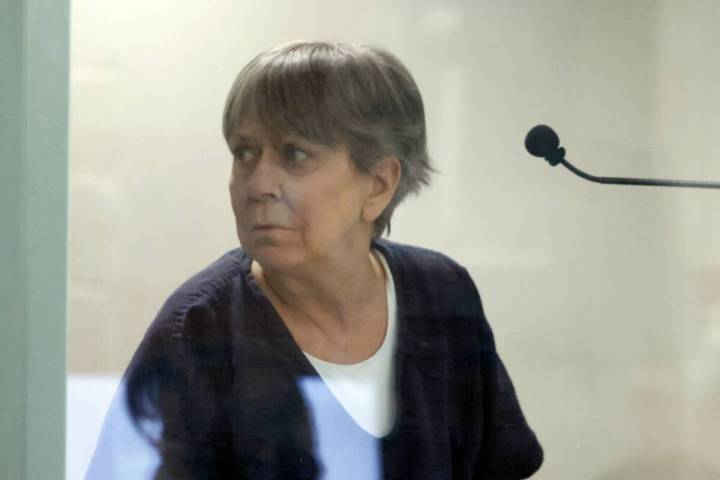
But the confrontation had been reported to Las Vegas police, setting in motion a chain of events that ended with the teenager dead at his mother’s feet.
Things began to escalate when several police units arrived at the Sunridge Apartment Homes, 4855 Vegas Valley Drive, near Nellis Boulevard, about 5:13 p.m. Officers responding to a call of a “subject with a knife” surrounded them with their guns drawn, Oquendo said Wednesday.
Chamberlain, who was holding a knife with a 4 1/2 inch blade, must have been frightened, his mother said. The teen jumped behind her and grabbed her. He held the blade parallel to her throat, inches away from it.
“They said, 'Drop the knife.’ I said, 'Don’t shoot,’” said Oquendo, describing her exchange with police.
The encounter with officers flashed by in 30 seconds, she said. It ended when a Las Vegas police officer pulled the trigger.
“The next thing I heard was a gunshot, and then I saw my son with his brains blown out on the ground,” Oquendo said.
The grieving mother questioned why police had used deadly force. She said she never felt her life was in danger.
According to Las Vegas Metropolitan Police Department policy, officers are authorized to use deadly force to protect themselves or others “from what is reasonably believed to be an immediate threat of death or serious bodily harm.”
Police Protective Association union President Chris Collins said the officer — whose name won’t be released until 48 hours after the shooting per department policy — made the right decision.
“Those officers took the actions they did to save the life of that woman last night,” Collins said. “Every one of those officers have to react in a split second to what they see.”
Had police been drawn into a lengthy negotiation with the teen who then slit his mother’s throat, Collins said, police would have been culpable for her death.
Oquendo doesn’t see it like that.
“They murdered my son,” she said. “They shot at his head. They could have shot at his arm. They could have shot at his leg. They could have Tasered him. They aimed to kill.”
Las Vegas police officials on Wednesday did not release additional details of the officer-involved shooting.
“This is an ongoing investigation,” Las Vegas police spokesman Bill Cassell said. “We’re not going to make any comments about anything relating to this.”
A coroner’s inquest jury will be convened to decide whether the shooting was justified, excusable or criminal. The officer who fired his weapon has been placed on paid administrative leave pending the outcome of the inquest.
Oquendo said Tuesday that was the first time her son had been violent with her. Oquendo said her son “snapped” and started breaking things. She said he pulled her hair and punched her in the head. She said he did not hurt her.
Oquendo said her son was diagnosed with bipolar disorder when he was 14. He refused to take any medication because he didn't want to stifle his creativity, a family member said.
According to the Journal of the American Medical Association, individuals with the disorder alternate between states of deep depression and extreme elation. The cause is thought to be chemical changes in the brain.
During Chamberlain’s rampage, he broke a television set and a computer and slashed some canvas paintings. Oquendo said that although he had the knife while in the apartment, he never threatened her with it.
Oquendo said her son then took 10 of her Klonopin pills, a prescription medication commonly used to treat seizures and panic disorders.
She said she told her son that he might kill himself by taking so many pills. He told her that it wouldn’t kill him and that he didn’t want to die.
Oquendo said the fight inside the apartment lasted 30 to 45 minutes. She didn’t call police, she said, because she was afraid they would shoot her son. Oquendo said a friend of hers eventually connected and told the dispatcher that a teenager was bipolar and having a manic episode at the apartment.
“I wasn’t looking to have him arrested,” she said. “I wanted him medicated and taken to a psychiatric hospital.”
Oquendo said her son told her before the police arrived that he didn’t want to get shot. She suspects her son used her body as a shield between himself and the police.
“It was just a display,” Oquendo said. “He wasn’t going to hurt me.”
On Chamberlain’s MySpace page, the teen’s profile includes the word “impulsive” above his name and lists his mood as “high.” He last logged into the social networking site Tuesday.
On Wednesday, a small plaque bearing his name was added to a memorial rock outside Chaparral High School, where he was a junior. He also will be included in a memorial Friday afternoon during a football game.
Isaiah Quiambao, 15, said Chamberlain was his best friend for the past three years. He heard of his friend’s death on the news late Tuesday but decided to wait until he got to school Wednesday to confirm it.
“I didn’t really want to believe it,” Quiambao said. “My friends came up to me and asked if I heard about Tanner. I broke down and cried right there.”
He recalled Chamberlain as a friendly and talkative person who thrived in theater class.
“It was his inspiration,” he said.
Students created a large banner for Chamberlain in theater class, and Quiambao said he was surprised by how many people signed it.
Grief counselors were on hand at the school to help students.
Chamberlain had told Quiambao that he was bipolar.
“This is the first time he’s done anything like this,” he said of Tuesday’s violence.
Oquendo said her son was a versatile teen with many interests. Earlier this year, he played Oberon in Shakespeare’s “A Midsummer Night’s Dream.” She said her son took advanced placement classes and hoped to attend an Ivy League university.
She said her son was well-read, wrote poetry and was a yellow belt in jujitsu.
The 49-year-old single mother who works as a blackjack dealer at the Bellagio said she didn’t know how she was going to move forward without her son.
She’s contemplating a lawsuit.
“We were a team since he was born,” she said. “It’s always just been him and I. He’s the reason why I get up every morning. He was my reason for living.”
Review-Journal reporters Maggie Lillis and Lawrence Mower contributed to this report.
Contact reporter Antonio Planas at aplanas@reviewjournal.com or 702-383-4638.