Quantcast
Home manage Las Vegas Review-Journal
  Jobs Cars Homes Shopping Travel Weddings Golf Best of Las Vegas Photo   Search:

RECENT EDITIONS
Sun Mon Tue Wed Thu Fri Sat

sponsored by
News


Astronomer puzzles over universe

$450,000 grant pays for researchers, helps UNLV cover upkeep


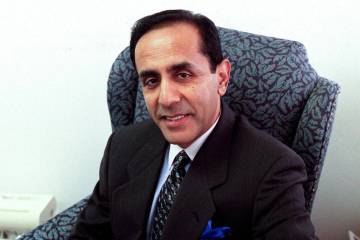
Ken Nagamine is trying to figure out where you came from. Specifically, where the molecules that make up your body came from, or at least how they came together to form a person.

He wants to know the origins of the Earth, the sun, the galaxies, the supermassive black holes and the exploding stars and the space gases and the atoms within those gases. How did all that stuff come together to form things?


Most Popular Stories
  • Three suspects arrested in shooting death of police officer
  • Three suspects arrested in shooting death of police officer
  • FATAL SHOOTING: Police again mourn comrade
  • NORM: Biden finds rank has its privileges
  • NORM: Walton: Coach deserved a punch
  • Two of three suspects in slaying of officer could face death penalty
  • DEADLY HOME INVASION: Police suspect link to family
  • Station Casinos posts $455 million third-quarter loss
  • Las Vegas police shoot at man fleeing after traffic stop
  • Las Vegas police shoot at man fleeing after traffic stop
  • UNLV sacks football coach Sanford
  • NORM: CityCenter seeks presidential visit


  • He's studying all this from a closet-sized office at the University of Nevada, Las Vegas, with a computer screen the size of a nice TV. He's doing this, too, with half his brain tied behind his back, by his estimate.

    But Nagamine, 35, an assistant professor of astronomy who is originally from Japan, is also doing it with a $450,000 grant from the National Science Foundation, which helps pay for extra brains -- about 4.5 extra brains, again, by his calculation.

    Those extra brains belong to student researchers who get paid through the grant.

    The grant, officially, allows Nagamine to study black hole feedback and galaxy formation -- a unique enough goal from an admittedly young and comparatively inexperienced researcher that he was able to snag an ultra-competitive NSF grant.

    The grant, which runs for three years, also covers many other things: general upkeep of the university (about 46 percent of the money), a good portion of Nagamine's own pay (about 15 percent), travel expenses, publication expenses, and so on.

    So, for Nagamine's state salary of $72,072, the university gets that back several times over because of the grant. In addition, he's employing a post-doctoral student at a hefty salary, a couple of graduate students and five undergraduate students.

    Which means that, in addition to being a teacher of introductory astronomy and a researcher studying the Big Questions of the Universe, Nagamine is also a small business.

    And, say university officials, he is pretty typical of young science faculty members at the university.

    Though not all of them are working with large federal grants, the university's leaders say many of them are. Last year, the university brought in $40 million in research funding. Though that's not much when compared to major research institutions, researchers point out that $40 million is still a lot of money.

    Typically, as in Nagamine's case, nearly half of grant funding goes directly to the university. The rest pays for research assistants, equipment and the like.

    And, said UNLV President Neal Smatresk, the latest in a line of UNLV presidents who want the university to focus more on research, there are other benefits, too.

    "Maybe, just maybe, we're solving some real problems," he said.

    Take Carl Reiber, a professor and the associate dean of the College of Sciences.

    Reiber is about to launch a research project studying zebrafish in such a way that it might, he hopes, lead to a treatment for children with a rare chromosomal disorder called Williams syndrome.

    The potential practical benefits from that and other research also translates to the classroom. It keeps Reiber and his graduate assistants up on the latest developments in the field, which they bring into the classroom.

    The same goes for Nagamine.

    He came to the United States for graduate school, studying at Princeton and Harvard universities before joining UNLV in 2006.

    He uses data gathered by astronomers all over the world. He feeds it into complicated computer programs, adds and subtracts a variable here and there, and tries to figure out how the universe ended up the way it is.

    From the big bang onward, apparently random particles have gathered together to make everything that we know exists. And it's still going on.

    He tries to simulate a supernova -- that's an exploding star -- in his computer to see what happens.

    "We're basically trying to understand the origin of all the structures in the universe," he said. "Including us."

    He figures he has three duties as a professor: teaching, research and other, which includes advising and lecturing outside the university.

    "It's a really time-demanding job," he said.

    But with the grant, he gets all those extra brains: the student researchers.

    That is the crux of why the university has been striving toward a more research-oriented approach.

    Though Smatresk acknowledged that the goal is still a long way off, and that it may be delayed during the state's ongoing budget crisis, he said the university is making steady progress.

    Total external funding -- that's grants and contracts, largely -- topped $76 million last year, up almost 4 percent from the year before.

    Smatresk said the university is trying to make "high impact" hires only right now, recruiting the kind of professors who not only will conduct great research, but who will enhance the university's reputation.

    Imagine, he said, if UNLV were to become the major research institution its leaders have been working toward making it for the last decade. What then?

    Why, more Ken Nagamines, of course.

    Contact reporter Richard Lake at rlake @reviewjournal.com or 702-383-0307.

    Newsvine Digg Fark Technorati reddit StumbleUpon del.icio.us Slashdot Propeller Mixx Furl Twitter MySpace Facebook Google Bookmarks Yahoo! Bookmarks Windows Live Favorites Ask MyStuff myAOL Favorites

    Leave Your Comment 27 Reader Comments
    Terms & Conditions
    The following comments are provided by readers and are the sole responsiblity of the authors. The reviewjournal.com does not review comments before publication nor guarantee their accuracy. By publishing a comment here you agree to abide by the comment policy. If you see a comment that violates the policy, please notify the web editor.

    Some comments may not display immediately due to an automatic filter. These comments will be reviewed within 48 hours. Please do not submit a comment more than once.
    Current Word Count:

    Note: Comments made by reporters and editors of the Las Vegas Review-Journal are presented with a yellow background.

    Guy ought to be a firefighter! wrote on October 05, 2009 05:43 PM: considering all you need is a high school education to be a fire fighter and make 100's of 1,000's a year in salary and "over time", why is a guy with intelligence hanging out at UNLV which is paying him peanuts? Doesn't make sense, none of it does.


    Steve wrote on October 05, 2009 04:20 PM: Dana: sorry to disappoint, the scientific content of genesis is zero.


    Steve wrote on October 05, 2009 04:19 PM: John, it depends how you frame the question. If the $6bn number for NSF is correct that translates into $20 per person in science funding per year. That is 5 cents per day for ALL science projects in this country (not just Ken's).

    The question is whether science is "non-essential" spending. My answer is of course not.

    To: "To Steve"

    It's time to make tough decisions. OK, science is in, wars of aggression are out. The payoffs to science vastly exceed almost any other activity you can think of.

    To: "Too much government"
    I put to you that basic science is a "public good" that is likely to be under-invested in by private individuals but makes everyone better off.


    Dave wrote on October 05, 2009 04:15 PM: Hey "Tim"? Did you get some sort of degree in "Astronomy"? How's that working out for you? LOL


    butcher wrote on October 05, 2009 04:12 PM: The Univ.Utah has developed a way to see through walls via radiowaves making it rough on our enemies.Yea, without science,no computers,cellphones TV,radio,planes autos,you'd would be like the pioneer rolling along to nowhere.This kid is great an inventor.Take the man who convinces you to cut off the perfectly good tail pipe from your car and replace it with a $30.00 noisy one ? It's all about education,so,you don't make foolishness errors and like put money in a Bank,huh Tom.


    John wrote on October 05, 2009 03:44 PM: Congrats to Ken Nagamine and UNLV which won funding that would have otherwise gone to another state. But I'd have to agree with the comments of "This is Insane." Our congress and the president don't have the courage to cut non-essential spending to save this country from bankruptcy. Already Russia, China, and Saudi Arabia are in talks of dumping the dollar because of the uncontrollable spending and the devaluation of the dollar. Do we need to know where the molecules of our bodies comes from right now? Can the research wait another 5 years until the US gets back on its feet again? I would rather see that money go back into the pockets of small businesses or the individuals who earned it. I am curious how many pay-pal donations I would get if I posted a request to the general public for such funding?


    oh no, taxes!!!! wrote on October 05, 2009 02:52 PM: Too_much_government:

    Before you post any additional comments, please read the Constitution, specifically, the taxing and spending clause.


    Dana Teepe wrote on October 05, 2009 02:49 PM: It might be helpful for Mr. Nagamine to use the literary source, The New King James Bible, The New American Standard Bible and or the New International Bible in part of his research. There is scientific information in Genesis Chapter 1-5 if researched in depth from a scientific viewpoint.


    Tom wrote on October 05, 2009 01:51 PM: Nice, he gets all that money. Meanwhile I sit here wating now over 45 days for the FDIC to pay me on my insured accounts that were in Community Bank. Soon we will all be fighting in the streets, war is coming as America goes down the tube.


    Too_much_government wrote on October 05, 2009 01:30 PM: Get the government OUT of higher education research funding (NSF/NIH/etc). Here's what it boils down to: the crooked politicians steal money from productive R&D/commercial firms like Intel (I am not a stock/stake/holder) to give to guys like Nagamine. If Ken wants wants to gaze at the stars, he can do it on his time/dime.

    This is all about unseen costs. Why do politicians get to pick winners and losers? Many promising sci/tech ideas out there (here in NV?) will NEVER receive venture funding because of government wealth transfer schemes like this; many small, independent inventors are forced to cease. How many fewer nano-devices will be created in order to pay for these university research programs nobody really wants?


    Read All Comments