News

Hope fades for growing number of homeless in Las Vegas

  • Jessica Ebelhar/Las Vegas Review-Journal

    A homeless encampment has sprung up along Owens Avenue near A Street at the edge of downtown's homeless corridor. The number of people living on the streets in and around the corridor has more than tripled since 2009, according to a January homeless count. » Buy this photo

  • Jessica Ebelhar/Las Vegas Review-Journal

    Darla Hatcher cries as she talks about how she spent the night outside a business on Main Street. Social service providers are seeing an increasing number of homeless while resources to help them dwindle. » Buy this photo

  • Jessica Ebelhar/Las Vegas Review-Journal

    Brian, who declined to give his last name, has been sleeping in the bed of his pickup with his father and his dog, Big Al Capone. He gets a monthly check from the Army. "So many people are just one paycheck away from this," the 43-year-old said. » Buy this photo

  • Jessica Ebelhar/Las Vegas Review-Journal

    Kathy Dowd, 54, is among the valley's "new" homeless -- people who have never before found themselves with no place to go. Dowd, who has 20 years' teaching experience, has been living at The Shade Tree Shelter for more than a year. "Because of the economy, there are a lot of people in here who worked hard for years," she said. "We're not all on drugs or alcohol. We're not all winos and bums." » Buy this photo

  • Jessica Ebelhar/Las Vegas Review-Journal

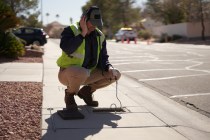
    Eric Janson, with the city's Rapid Response Team, cleans up items left by homeless people in a former trailer park in downtown's homeless corridor. Donations such as food and blankets given directly to people in the area often wind up discarded. » Buy this photo

  • LAS VEGAS REVIEW-JOURNAL

By Lynnette Curtis
LAS VEGAS REVIEW-JOURNAL
Posted: Nov. 6, 2011 | 1:59 a.m.
Updated: Nov. 6, 2011 | 7:46 a.m.

Come here at night and you'll see scores of them, lying side-by-side in the open or huddled inside tents, banding together to form their own makeshift communities.

Many of them scatter when day breaks. But, especially lately, plenty of destitute campers remain around downtown's homeless corridor even by day, squatting along the sidewalks or in empty lots, panhandling or simply wandering toward nowhere in particular.

"I'm not enjoying this lifestyle at all," a bearded man in his 50s says while smoking next to his duffel bag on Foremaster Lane near Las Vegas Boulevard.

But he can't go to a shelter, he says. "They've been filling up too fast."

Early this year, Southern Nevada got some good news for a change. Despite the still dismal economy, significantly fewer people overall were homeless in the valley than in 2009, according to a large-scale January homeless count.

But a closer look at the results of that count revealed some disturbing trends. The number of people actually living on the streets, those most of us think of as "homeless," had climbed dramatically. That disparity was made possible because the official, broader definition of homelessness includes people living in shelters or transitional housing.

Particularly troubling was the steep increase in homelessness in the area surrounding downtown's homeless corridor, a cluster of shelters, empty lots, beleaguered businesses and graveyards near Foremaster and Las Vegas Boulevard that officials call the Corridor of Hope. The number of people on the streets in the area spiked by 230 percent between 2009 and 2011, according to the count.

Some say they've seen conditions there this bad only once before: in the months following 9/11, when tourism ground to a halt.

"So many families never expected the next paycheck wasn't coming" at the that time, said Marlene Richter, executive director of The Shade Tree shelter for women and children. "But that was for a period of a few months. This time, it's been years."

Meanwhile, most homeless service providers in the area are making do with decreased funding and fewer resources -- a losing combination.

"We are turning away up to 10 families a day," Richter said. "There is no more shelter, no new facilities. That safety net is gone."

A CLOSER LOOK AT THE NUMBERS

Every two years, hundreds of volunteers gather to conduct a point-in-time homeless count meant to give social service providers an idea of how the local homeless population has changed. They fan out across the county in cars and on foot for a nighttime street count, which is then combined with tallies from local shelters, hospitals and other sources for an estimate of the number of homeless people living here on a given day.

Such censuses are required every two years to apply for federal grant money to fight homelessness.

This year, regional officials were pleased to discover that the overall homeless population had shrunk by nearly 30 percent, from 13,338 in 2009 to 9,432 in 2011.

They attributed the decrease in part to better collaboration between local government, nonprofits and faith-based groups that help the homeless.

But some social service providers said the overall numbers didn't reflect the reality of what they were seeing.

"We haven't seen a decline in terms of the shelter services we're providing," Phillip Hollon, vice president of plaza services for Catholic Charities of Southern Nevada, said in May.

The charity's shelter in the homeless corridor is full every night, he said, and workers have to turn people away.

"Maybe they wind up in someone's backyard," he said.

Indeed, the count revealed that while the overall number of homeless had decreased, there was a sharp increase in the number of unsheltered "street" homeless, from 3,027 in 2009 to 4,241 in 2011.

The overall decrease was thanks to shrinking numbers of "sheltered" and "hidden" homeless, people living in homeless shelters, transitional housing and in unconverted garages or other private property not meant for shelter.

It follows that some of those people wound up on the streets.

And the number of "street" homeless may be even higher, because they are notoriously hard to count. They stay hidden for privacy and safety.

About 29 percent of the entire valley's street homeless, or about 1,245 people, were found in or around downtown's homeless corridor, where they tend to gather because of resources available there. In 2009, that number was 377.

Those who work with the homeless say the resources aren't enough and are even shrinking, leaving them to worry just how bad things could get.

"It scares me we're going backwards to a time when people spent five or six years living on the sidewalk," Richter said.

THE SHRINKING SAFETY NET

Social service providers say more people are living on Las Vegas Valley streets in part because safety-net programs were cut at the same time need increased in a dismal economy.

One of the cuts with the biggest impact was to the county's emergency rental assistance program, which provides eligible individuals $400 a month to stave off homelessness.

The county's budget for emergency rental and other financial assistance this year is $3.8 million. Two years ago, the county spent $12 million.

The cuts were necessary in part because the county had to assume more Medicaid costs from the state, said Tim Burch, interim director of Clark County Social Service Department.

As a result, the county had to slash the length of time most people can receive rental assistance each year from 90 days to 30.

"As the state shifts more of the burden to us, we have to shift it elsewhere," Burch said. "It puts a burden on non­profits and other service providers in the Corridor of Hope. It puts a strain on the overall community safety net."

Linda Lera-Randle El, director of the Straight from the Streets homeless outreach program, said such cuts threaten to destroy the progress service providers managed to make over the years by working together.

"Whatever we accomplish in one area is taken away in another," she said. "We come together and unify and support each other, and then somebody pulls the rug out."

County support for Catholic Charities also has shrunk, leaving the downtown shelter with fewer emergency beds.

And because of budget cuts and a scarcity of employment opportunities, the charity had to gut its resident work program, which previously provided up to 400 men with shelter and job placement assistance. The program's new capacity is 125.

Meanwhile, "we're seeing more in need in this corridor than ever before," Hollon said.

He said the shelter has been turning more men away.

So has the Las Vegas Rescue Mission, which this year was actually able to increase its shelter space thanks to private donations. Still, it wasn't enough.

"A good number of those people (on the street) are there because they tried to get in some place and it was full," said Bob Brunner, the mission's executive director. "Unfortunately we do have to turn people away."

Major Robert Lloyd, Clark County coordinator for the Salvation Army, said, "All you have to do is drive down to the area" to see the increased need.

"There are not enough beds. Look at the people outside, and you realize the shelter is full."

THE NEW HOMELESS

Kathy Dowd, 54, is an educated woman with 20 years' teaching experience.

She can intelligently discuss the plays of Shakespeare, lead poetry workshops and lecture on early childhood development.

She also is among the new faces of homelessness, the type of person social service providers are seeing more and more.

"I've always been able to get a job," said Dowd, who has been living at The Shade Tree for more than a year. "I've worked my whole life."

Dowd found herself in trouble after taking a hiatus from her teaching career to care for her ailing mother in Colorado. When her mother died, Dowd came to Las Vegas to start over. But what little money she had went quickly, and she found herself doing something she never imagined: going to a homeless shelter.

"People wonder how I ended up here," she said. "Because of the economy, there are a lot of people in here who worked hard for years. We're not all on drugs or alcohol. We're not all winos and bums."

Las Vegas City Councilman Ricki Barlow, whose ward includes the homeless corridor, said those who lost jobs and homes are now landing on the streets.

"These are individuals who had homes and full-times jobs, who were providing for their families," he said. "These are the individuals who wound up sleeping on relatives' and friends' couches. Now, they're out there."

Many of the newly homeless struggle to find the help they never needed before.

"They are our former co-workers and neighbors," Richter said. "They were working and had goals and plans. They found themselves in a situation they are completely unprepared to survive."

WHAT CAN BE DONE

Social service providers would like to have more money and resources, and especially more jobs for the down-and-out. But they also are hopeful about a program in the works that would encourage churches and other faith-based institutions to "adopt" a homeless family or individual for a year.

The congregations of such institutions would serve as support groups for the homeless person or family they adopted, said Tyrone Thompson of the Southern Nevada Regional Planning Coalition's committees on homelessness and youth.

"The congregation would help them navigate through the process, find food stamps and other benefits," he said.

The program is being developed in partnership with Family Promise, a nonprofit organization that helps homeless families in part by partnering with faith-based organizations, Thompson said.

Lloyd, from the Salvation Army, said he would like to see churches pursue more partnerships with existing homeless service organizations instead of trying to start their own.

"It's always demoralizing when you need help and a church wants to know how to start its own social service agency or food bank," he said. "It's demoralizing when you see those churches feeding people out of the back of a vehicle and not picking up the garbage."

Donations such as food, clothing and blankets given directly to people in the homeless corridor often wind up discarded on the street. City cleanup crews regularly sweep everything up.

"It really builds up," said Las Vegas police officer Mark Washington, part of the department's Homeless Evaluation Liaison Project (HELP) team. "There are a lot of good-hearted people out there; but when you give resources to people on the street, a lot of times it goes to waste."

Contact reporter Lynnette Curtis at lcurtis@reviewjournal.com.

Comments

Registration Notice: The Review-Journal has implemented a new registration procedure that requires all existing and new accounts to validate and login using Facebook. Visit the Registration FAQ for more information.
Terms & Conditions

The following comments are provided by readers and are the sole responsiblity of the authors. The Review-Journal does not review comments before publication nor guarantee their accuracy. By publishing a comment here you agree to abide by the comment policy. If you see a comment that violates the policy, please use the Report Abuse button.

Some comments may not display immediately due to an automatic filter. These comments will be reviewed within 24 hours. Please do not submit a comment more than once.

Note: Comments made by reporters and editors of the Las Vegas Review-Journal are presented with a yellow background.

  1. he hate me Nov. 7, 2011 | 2:25 a.m. Report Abuse

    I blame the democrats

  2. No More Pizza Nov. 7, 2011 | 1:56 a.m. Report Abuse

    I love the homeless.

  3. craig campbell Nov. 6, 2011 | 9:57 p.m. Report Abuse

    yeah, next time reids leader comes to vegas,don't go to east valley neighborhood, bring him to las vegas blvd north,and he can takes the names of the homeless and instantly help them just like when he was elected with that black women at that press confrence.

  4. vegas_tink Nov. 6, 2011 | 9:26 p.m. Report Abuse

    I want some of what jt is smoking! Now back to the article, I used to live near an open shelter. Anytime I went for a walk, to work, the gas station, anywhere I had to run a gauntlet of people pretending to want to work for food or just boldly asking for money. Hell, my Brother was one of them. Any money he could get flashing a sign went for heroin. Just as most of these people he always had money for cigarettes. I understand some people are there because of dire straits, but my guess that's a small number. There are jobs out there, especially in the medical fields, if you are willing to get the training. Who promised you life was going to easy? You want to help someone? Go volunteer at the Blind Center or a Nursing Home and do something for someone that truly can't help themselves.

  5. Jerry S..Dickinson Nov. 6, 2011 | 8:26 p.m. Report Abuse

    The homeless will be gone soon, worry not. With the temp going down, the homeless will follow. Down to Tucson, Yuma,San Diego.
    Similar to the Snow Birds we see driving thru Las Vegas this time of year in their $500,000 motorhomes and $30,000 chase cars. The homeless are more like DoDo birds and they take freight trains.

  6. Jerry S..Dickinson Nov. 6, 2011 | 8:22 p.m. Report Abuse

    jtwightman.. very good observation. I have thought that from the beginning. To phrase it a little simpler,"when you rob Peter to pay Paul, Paul will always vote for you."
    Further, I believe the O'Drama machine is behind the OWS gang. I was dismayed when Clinton was elected twice. In my lifetime I learned about Integrity from Pres. George Washington. I learned about a complete lack of it when Clinton stated, on national T.V " that depends on your definition of the word is..."! Now, we are seeing a sitting President creating civil, social and cultural discontent, advocating the behavior witnessed within the OWS circus. I thought Clinton was the moral low for this Nation. I wasn't even close.

  7. elveret.odamit Nov. 6, 2011 | 8:17 p.m. Report Abuse

    Obama made tons of promises to get elected and kept 2. Make a change---- for the worst and make you live on chump change.

  8. jtwightman Nov. 6, 2011 | 7:59 p.m. Report Abuse

    Barack Obama is no fool. He is not incompetent. To the contrary, he is brilliant and a liar. He knows exactly what he's doing. He is purposely overwhelming the U.S. economy to create systemic economic failure. He knows crisis and social chaos -- thereby destroying capitalism and our country from within. Obama is following the plan of Cloward & Piven, two professors at Columbia University. They outlined a plan to socialize America by overwhelming the system with government spending and entitlement demands. Add up the clues below. Taken individually they're alarming. Taken as a whole, it is a brilliant, Machiavellian game plan to turn the United States into a socialist/Marxist state with a permanent majority that desperately needs government for survival ... and can be counted on to always vote for bigger government. Why not? They have no responsibility to pay for it.

  9. jtwightman Nov. 6, 2011 | 7:58 p.m. Report Abuse

    Universal health care. The health care bill had very little to do with health care. It had everything to do with unionizing millions of hospital and health care workers, as well as adding 15,000 to 20,000 new IRS agents (who will join government employee unions). Obama doesn't care that giving free health care to 30 million Americans will add trillions to the national debt. What he does care about is that it cements the dependence of those 30 million voters to Democrats and big government. Who but a socialist revolutionary would pass this reckless spending bill in the middle of a depression?

  10. jtwightman Nov. 6, 2011 | 7:58 p.m. Report Abuse

    Cap and trade. Like health care legislation having nothing to do with health care, cap and trade has nothing to do with global warming. It has everything to do with redistribution of income, government control of the economy and a criminal payoff to Obama's biggest contributors. Those powerful and wealthy unions and contributors (like GE, which owns NBC, MSNBC and CNBC) can then be counted on to support everything Obama wants. They will kick-back hundreds of millions of dollars in contributions to Obama and the Democratic Party to keep them in power. The bonus is that all the new taxes on Americans with bigger cars, bigger homes and businesses helps Obama "spread the wealth around."

Read All Comments

Friday, May 25, 2012
Overcast Overcast, 79° Weather Forecast