Comments (45) | Add a comment
Developers unveil proposal for UNLV stadium complex
-
MIKE JOHNSON/LAS VEGAS REVIEW-JOURNAL
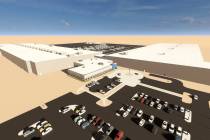
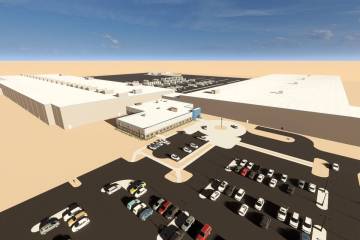
UNLV stadium proposal » Buy this photo
Tools
LAS VEGAS REVIEW-JOURNAL
Updated: Feb. 2, 2011 | 7:20 a.m.
If the loose plan to build a stadium, retail complex and thousands of units of on-campus housing and hotel rooms at UNLV ever actually happens, it would transform the university.
The plan, unveiled Tuesday by the high-powered developers who back the idea, would see about a third of the campus's 332 acres turned into an integrated village.
"There is no college president in the country who wouldn't dream about seeing a project like this," said Neal Smatresk, president of the University of Nevada, Las Vegas.
But that's about all it is right now, a dream.
There is no financing in place. No hard and fast designs. No agreements with the necessary government entities. Not even a guess as to the total cost or the year it might be finished.
It's too early to say, Craig Cavileer, president of the Silverton Casino, repeated over and over again as news media representatives hurled questions at him at Tuesday's press briefing.
As word leaked out in recent weeks of the plan, backed by Cavileer and business partner Ed Roski, chairman and CEO of Majestic Realty, the focus has been on the proposal's centerpiece, a 40,000-seat domed stadium that would house UNLV's football and basketball teams.
But, as Cavileer took pains to note again and again, the proposal is about much more than a football stadium.
"We see this as a reviving of the UNLV brand and what it stands for," said Cavileer, who is a member of the UNLV Foundation's Board of Directors.
Roski is part owner of the Los Angeles Lakers of the NBA and the Los Angeles Kings of the NHL. Majestic Realty is the primary developer of that city's Staples Center and is the largest privately held real estate developer in the country. It has been operating in Las Vegas since 1984 and has developed 6.7 million square feet of retail space here.
The plans at UNLV would call for:
The stadium, which theoretically could adjust in size to seat anywhere from a few thousand people to 40,000;
Refurbishing the Thomas & Mack Center, where UNLV currently plays its basketball games;
3,000 or more units of on-campus housing. Fewer than 2,000 of UNLV's 29,000 students currently live on campus;
600,000 square feet of retail space housing everything from restaurants to hotels to coffee shops;
The closing of Swenson Street;
Several parking garages with enough spaces for 15,000 or more vehicles;
An entryway on the south of the campus similar to that of Town Square, the upscale shopping and entertainment complex on South Las Vegas Boulevard;
An area designed to host tailgating parties and perhaps even housing for fraternities and sororities.
Cavileer and Roski are seeking an exclusive agreement with the university to develop plans for the campus transformation. They will present their ideas to the higher education system's Board of Regents on Feb. 11.
If the board approves the agreement, the university would be forbidden from negotiating with another entity for a similar project for however long the agreement lasts.
James Dean Leavitt, chairman of the board, said he had not yet seen the proposed agreement, so he had few details.
Both he and Smatresk emphasized that no UNLV or higher education system money would be committed to the project.
Cavileer said the developers have no plans to seek any public financing. He said the project would likely be financed through private and corporate donations, the developer's money, borrowing and revenues from a special improvement district, if approved .
The developers will ask the state Legislature to create a special improvement district, whereby any taxes collected on the development would be used to pay off bonds issued to fund it. In essence, the developers would keep revenues from their project and any sales taxes collected in the retail establishments.
They also will seek to lease land from the university for the project. When the lease is up -- it could be as long as 30 years, or more -- whatever is built would become the university's property.
Smatresk said the university could, in the long run, make money from the deal, as well.
Depending on the specifics of the project, the university could simply lease the land to the developers for a fee and collect no other money. Or, it could be a business partner and get a portion of the proceeds. Either -- or a combination -- is possible, eventually.
In addition to the university land, the developers are also seeking to gain control of a parcel across Swenson Street, at the northeast corner of Paradise Road and Tropicana Boulevard. That land is owned by McCarran International Airport and is leased to UNLV for parking.
Cavileer said the project still would go forward even if they could not get the airport land. With it, the project would total 150 acres.
Cavileer acknowledged that the university's proximity to the airport does present a challenge. There will be height restrictions in place. He said he was not yet aware of all the details, but that he was familiar as a developer in the Las Vegas Valley for 20 years with building near the airport. He said the plans call for buildings of no more than five stories on campus.
The stadium, which was mostly referred to as an "events center," would sit next to the Thomas & Mack.
UNLV's basketball and football teams would play games there, though the basketball team still could use the Thomas & Mack in case of a scheduling conflict.
UNLV's sports leaders were excited by the possibilities.
"I love the idea of having two options," said UNLV Athletic Director Jim Livengood.
"I would imagine it would be fantastic," said basketball coach Lon Kruger. "The Thomas & Mack is still a quality (arena) with a good history, and we'd still play there. But the Thomas & Mack, as good as it is, is 27 years old and we expect to move forward at some point."
Football coach Bobby Hauck said the new stadium would help recruiting.
"The last couple of weeks, we've shared it with them," he said. "Everybody's excited. We try to give them a realistic perspective on the time frame we're talking about, but it's exciting and it shows a commitment to improve the student life at the university."
The stadium also could accommodate professional sports, but Cavileer was quick to note that the project is not dependent on having a pro sports team here.
It is still unclear what would happen to Sam Boyd Stadium, seven miles from campus and the home to UNLV's football team since 1971.
The stadium being so far from campus was largely what spurred Cavileer to come up with the idea for the new development to begin with, he said. He grew up in Austin, where the football stadium is a part of the University of Texas campus, he said. He wants UNLV to be like that.
Smatresk said such a campus would be a boon to UNLV students. He said there is ample evidence that students who are more engaged with their campus, particularly those who live on campus, do better in school.
In addition, he said, the new facilities will not only make it easier to recruit top athletes, it will make it easier to recruit top students.
Smatresk said making UNLV better for the students is the whole point.
Review-Journal reporter Mark Anderson contributed to this story. Contact reporter Richard Lake at rlake@reviewjournal.com or 702-383-0307.
Trending topics:
Comments
Terms & Conditions
The following comments are provided by readers and are the sole responsiblity of the authors. The Review-Journal does not review comments before publication nor guarantee their accuracy. By publishing a comment here you agree to abide by the comment policy. If you see a comment that violates the policy, please use the Report Abuse button.
Some comments may not display immediately due to an automatic filter. These comments will be reviewed within 24 hours. Please do not submit a comment more than once.
Note: Comments made by reporters and editors of the Las Vegas Review-Journal are presented with a yellow background.


RSS

A couple of wealthy sports boosters should NOT be able to hijack the (questionable) mission of a state university. Nevada taxpayers should not be in the business of training the next generation of superstar athletes.
In the old days the crooked politicians (like LBJ) and their cronies would buy up hectares of worthless land and then see to it that new highways were re-rerouted to their wilderness front doors. Now they just "reroute" the campuses -- whose sites were originally chosen in rigged, highway-like fashion too.
This is all so obviously corrupt. It just goes to show you how arrogant these politicians have become. They do this out in the open. They know there's nothing you can do about it.
One thing I think might be feasible is to have a portion of the events that are maintained there to pay into it. Sides wouldn't most of the taxes be offset by the amount of workers in the area now working and buying say lunch or other products from local vendors? But inorder to improve anything everyone needs to give.
Also someone stated beds being 1000$ earlier. Room and Board is over 3000$ per semester. So not sure what numbers or facts he pulled.
Actually from what I read about the unveiling tigerm it is completely private funding. The only public part is UNLV donating the land. Just like the new Mendenhall Center.
I totally agree that this development would be amazing for UNLV and Las Vegas, but there is no mention of the price tag or how this would be paid for. The sheer size of the development would seem to cost anywhere from $400m to $1billion.
I suspect the people behind this will push for it to go to public ballot and ask the question in a skewed way that the public endorses it i.e. should the state give away this land so that it can provide thousands of jobs and create a special tax district to pay for this. The majority will vote 'yes' and then find out they are on the hook when the tax district fails to meet its revenue target and the state must make up any shortfalls.
Yes to the idea and vision, now lets talk $$$.
This plan is not viable in its current form. It is far too expensive. For example, the student housing can only be rented at rate of less than $1000 per bed per year. A project of this scale is not viable at at such a low rental rate. This entire project will fall apart as soon as a budget is created and presented to potential lenders.
YAWN. Much ado about nothing!
One other thing I would like to add. This state is so afraid to tax the casinos any more. States like Pennsylvania and Memphis tax their casinos at 50% and 25%. Yet they are still making a profit in those states. We will never diversify the major industries in this state unless we educate ourselves.
Where are the Solar Farms ? Nevada has plenty of sunlight and the right level to be a leader in that field. Yet no major power plants or jobs that come from it. What about investing in research labs to work on medical breakthroughs? Engineering jobs to help increase our infrastructure ? Oh wait that's right we would need educations in order to accomplish this. Perhaps we should just let other states do this since they know that having only one or two industries is the death of an area.
You know the funniest thing about taxes and education. Everyone wants an education but no one wants to pay for it. Most of the people I hear complain about taxes are people that no longer have children, are retired, or never went to school.
WHAT THE HELL ARE WE WAITING FOR .WE HAVE ENOUGH ILLEAGAL ALIENS TO BUILD IT NOW .THEN THE MONSTER JAM WILL BE THERE AND NOT BE AT THE SILVER BOWL WHERE THEY SELL OUT MONTHS BEFORE THE MARCH EVENT .BUT THIS MAKES SENSE .LIKE THE MONORAIL THAT DOESNT GO TO THE AIRPORT ..DUH WHO IS THE BRAINS BEHIND THAT
I've heard it's a "game changer." Will I be able to get a hard drink or just beer?