Opinion

Thomas Mitchell

If newspapers won't defend free speech, no one will

Posted: Jul. 11, 2010 | 12:00 a.m.

The concept of open government and its ancillary principles of access to public information, campaign finance disclosure and limitations and general transparency seem to befuddle some people, who overreach and try to apply it to private citizens as well as government actors.

Office holders and candidates for public office are creatures of the state, and can be required by law to limit the amount of campaign contributions they accept and disclose how they spend that money to be elected. There is no limit, under the First Amendment, on how much of their own money candidates may spend. Under the same principle, citizens are free to speak and write and spend as much of their own money as they please to deliver their messages to fellow citizens.

At least that's the principle.

Miscomprehension of this fundamental difference was on full display earlier this year when a private group out of Virginia was blocked from buying television ad time to independently promote the gubernatorial candidacy of Brian Sandoval because it failed to register with the state.

District Judge James E. Wilson Jr. of Carson City ruled, "Nevadans have a right to know who is behind election advertising. Continued violation of the statutes and depriving Nevadans of information about who is behind its election advertising will cause irreparable harm as voting will be influenced by unknown persons and voters will not have, through the proper channel, i.e., the Secretary, information they need to determine what weight to give the advertising."

I can find no such "right to know" enumerated in either the state or U.S. constitutions. If one must register with the state before being allowed to speak, that is the definition of a privilege, not a right.

The difference between private citizens and public actors was somewhat clarified by a 5-4 U.S. Supreme Court ruling in January in Citizens United v. Federal Elections Commission. It struck down much of the McCain-Feingold Act, which barred corporations and unions from spending money on independent advertising immediately prior to a primary or general election.

The clamor to negate the ruling with new restrictive legislation was immediate and widespread. President Obama attacked the ruling in his State of the Union address -- with members of the court in the audience. Congress introduced the mislabeled DISCLOSE Act (Democracy is Strengthened by Casting Light on Spending in Elections), and the House passed it in June. It largely exempts unions and favored lobbyists. Nevada Democrats Shelley Berkley and Dina Titus voted for it. Republican Dean Heller voted no.

The privileged elites on the editorial pages of both The New York Times and Los Angeles Times took time over the Fourth of July weekend to revisit the latest term of the Supreme Court in general and bemoan specifically the ruling in Citizens United.

Both are stupidly arguing against their own self-interests.

Monday's New York Times editorial, headlined "The Court's Aggressive Term" called Chief Justice John Roberts Jr.'s concurring opinion in Citizens United "the best guide to the court's most unsettling tendency."

Noting that Roberts wrote that the court should ignore precedence if prior rulings did damage to the Constitution, the editorial complained, "A decision can become an aberration, it turns out, if the court's conservatives never agreed with it in the first place. If not quite legislating from the bench, this is not a formula for stability."

Likewise, on Monday the editorialists at the Los Angeles Times called Citizens United the "best-known and most controversial 1st Amendment decision of the term."

The editorial argued the court could have ruled narrowly on the issue, but instead "the conservative majority of the court unnecessarily decided that corporations had a 1st Amendment right to spend their own funds on political advertising. One can disagree with the decision -- as we did -- and still note that it continued a tradition of the court imposing the strictest scrutiny on laws challenged on 1st Amendment grounds."

Both newspapers are owned by corporations that were exempted under McCain-Feingold. The dangerous nature of the thinking at the opposite-coast papers was pointed out by Justice Clarence Thomas while speaking to students at a Florida law school following the press uproar over the ruling. The irony did not escape him.

"I find it fascinating that the people who were editorializing against it (Citizens United) were The New York Times Company and The Washington Post Company, who were exempted by statute. So then it becomes a statutory right, not a constitutional right," Thomas observed.

Congress can revoke a statutory right. Are the two Timeses and the Post willing to depend on the fickle whims of Congress for their free press rights?

Some people have an agenda so rigid they are willing to risk their freedoms, their rights and their livelihoods. Down that path lies tyranny.

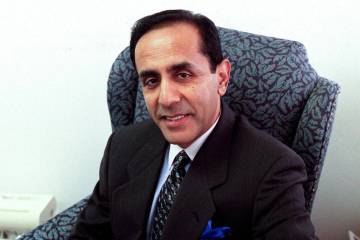
Thomas Mitchell is editor of the Review-Journal and writes about the role of the press, free speech and access to public information. He may be contacted at 383-0261 or via e-mail at tmitchell@reviewjournal.com. Read his blog at lvrj.com/blogs/mitchell.

Comments

Registration Notice: The Review-Journal has implemented a new registration procedure that requires all existing and new accounts to validate and login using Facebook. Visit the Registration FAQ for more information.
Terms & Conditions

The following comments are provided by readers and are the sole responsiblity of the authors. The Review-Journal does not review comments before publication nor guarantee their accuracy. By publishing a comment here you agree to abide by the comment policy. If you see a comment that violates the policy, please use the Report Abuse button.

Some comments may not display immediately due to an automatic filter. These comments will be reviewed within 24 hours. Please do not submit a comment more than once.

Note: Comments made by reporters and editors of the Las Vegas Review-Journal are presented with a yellow background.

  1. Green Dragon Regular Jul. 12, 2010 | 9:39 p.m. Report Abuse

    @Marla T.-

    Why, then, don't you start your own newspaper?

    Oh, so it's an FEC rule, NOT a right that is guaranteed by the Constitution! So FEC rules trump the Bill of Rights?

  2. Marla T. Jul. 12, 2010 | 2:35 p.m. Report Abuse

    @Green Dragon: 1) My words printed here have been read by an unknown number of people and commented on by 6 people. That's not exactly equal representation compared to the size of the RJ's subscription list. 2)Not the Bill of Rights. The Federal Election Committees rules on Disclosure of Political Ads and Solicitations, created because of this very type of situation.

  3. ScottNV Jul. 12, 2010 | 9:40 a.m. Report Abuse

    The LA Times reprinted one of the RJ's recent editorials on the Obama visit.
    Will you be accusing them of theft and suing them?

  4. Green Dragon Regular Jul. 12, 2010 | 5:55 a.m. Report Abuse

    @Marla T.-

    1) And your words printed here are not dissenting opinion?

    2) I've read and re-read the Bill of Rights. The right to free speech is pretty clear. The right to know who, exactly, is saying what, not so much. Could you help me out there?

  5. Jack.Sprat Jul. 11, 2010 | 11:59 p.m. Report Abuse

    I thought Howard Stern and Larry Flynt were protecting free speech. All you do is whine a lot.

    And sue people!

  6. Chandler_L Jul. 11, 2010 | 2:52 p.m. Report Abuse

    Is this the reason that the RJ is litigating through a third party for copyright infringement? Not protecting free speech but speech for sale?

    RJ, turn in your journalism card.

  7. Nomad84 Jul. 11, 2010 | 2:13 p.m. Report Abuse

    While there are those who think anything that is corporate inspired is evil, one only needs to look at the left leaning members of congress and the president to see that union money can lead to the detriment of the US.

  8. Marla T. Jul. 11, 2010 | 1:58 p.m. Report Abuse

    Your heading made me laugh for two reasons: 1) The RJ is heavily opinionated on one side of the political spectrum and rarely prints a word from anyone who disagrees with your position (heaven forbid a differing opinion should force the carefully constructed facade of the RJ's version of the facts to crack) and; 2) it actually has very little to do with your essay. It's incredibly laughable to see you go all lofty and noble on us about how you're just standing up for the First Amendment. Really? You?

    You're darn right the public has a right to know who is paying for which candidate. I'm just guessing but I think the FEC has similar feelings on the subject, which is why they created silly little disclaimer rules on political ads and solicitations.

    Come down from your lofty tower, Tom - all you're gonna get is a nose bleed.

  9. Marla T. Jul. 11, 2010 | 1:53 p.m. Report Abuse

    Your heading made me laugh for two reasons: 1) The RJ is heavily opinionated on one side of the political spectrum and rarely prints a word from anyone who disagrees with your position (heaven forbid a differing opinion should force the carefully constructed facade of the RJ's version of the facts to crack) and; 2) it actually has very little to do with your essay. It's incredibly laughable that you go all lofty and noble on us about how you're just standing up for the First Amendment. Really? You?

    You're darn right the public has a right to know who is paying for which candidate. I'm just guessing but I think the FEC has similar feelings on the subject, which is why they created rules on things like Disclaimers on Political Ads and Solicitations.

    Come down from your lofty tower, Tom - all you're gonna get is a nose bleed.

  10. Thomas Mitchell Jul. 11, 2010 | 11:35 a.m. Report Abuse

    TimeRanger: Gladly.

Read All Comments

Saturday, May 26, 2012
Partly Sunny Partly Sunny, 60° Weather Forecast